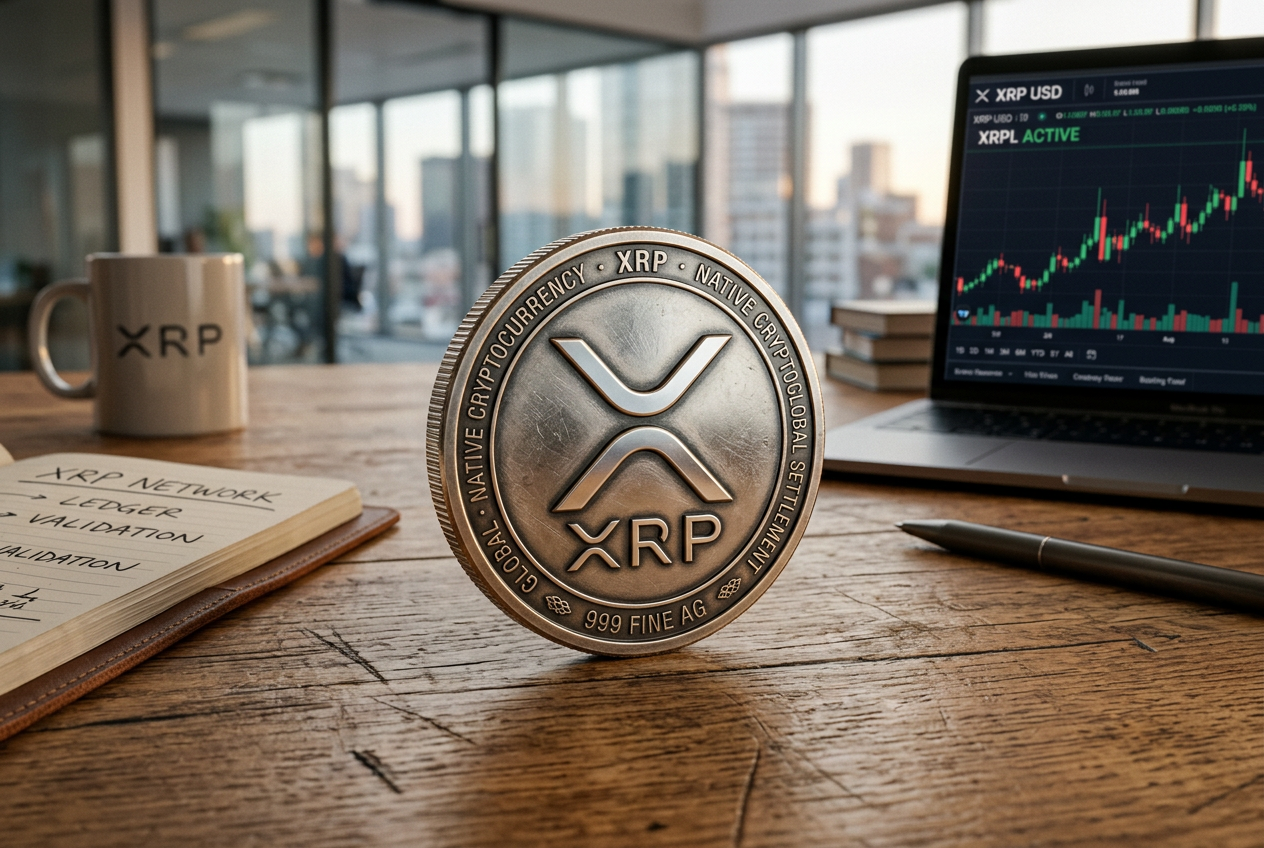
XRP, the Disruptive Technology that will Transform the World of Cross-Border Payments.
Read time:

Imagine sending money across continents in the time it takes to blink. No labyrinthine correspondent banking networks. No waiting three to five business days for funds to clear. No hidden fees gnawing away at your transfer. This isn’t a futuristic fantasy—it happening right now through the XRP Ledger, a blockchain platform that processes transactions for pennies and settles them in seconds.
For decades, the global financial system has relied on a patchwork of aging infrastructure to move money across borders. SWIFT, the venerable messaging network that connects over 11,000 financial institutions across 212 countries, handles an astonishing $5 trillion in daily transfers—but at a cost. Average transaction fees range from $20 to $50 per transfer, and settlement times can stretch from one to five business days. Enter XRP, the digital asset designed to replace this antiquated system with something faster, cheaper, and far more transparent.
Whether you’re an investor curious about XRP price prediction 2026, a finance professional exploring XRP cross-border payments, or simply someone bewildered by cryptocurrency jargon—this article will walk you through exactly how the XRP Ledger works, why it matters, and what the future holds for this transformative technology.
Understanding the XRP Ledger: More Than Just a Cryptocurrency
Let’s clear up a common source of confusion: XRP and the XRP Ledger are not the same thing as Ripple Labs, the company that builds products on top of it.
The XRP Ledger is an open-source, decentralized blockchain—the underlying technology that records all transactions. It was created in 2004 (long before Ripple Labs even existed) and became formalized in 2012 when Jed McCaleb, Arthur Britto, and David Schwartz launched the platform. XRP, the digital currency, is the native cryptocurrency of this ledger, used to facilitate transactions and provide liquidity.
Here’s where it gets interesting for the 1,500+ financial institutions now exploring this technology: the XRP Ledger is not owned or controlled by Ripple Labs. It’s a decentralized public infrastructure, though Ripple Labs builds commercial products (like RippleNet) that utilize it.
Total supply is capped at 100 billion XRP. Approximately 60 billion tokens circulate today, with the remainder held in escrow accounts and released programmatically to prevent supply shocks. This deliberate scarcity model provides predictability—a feature institutions crave when evaluating digital assets for treasury management.
How the XRP Ledger Works: A Deep Dive
Unlike Bitcoin or Ethereum, which rely on energy-intensive proof-of-work mining, the XRP Ledger uses a consensus protocol. Instead of competitive mining, participating servers (validators) agree on the validity of transactions through a consensus mechanism. This approach offers several concrete advantages:
- Speed: Transactions settle in 3-5 seconds on average
- Cost: A transaction fee of just $0.0002 per transfer
- Sustainability: Energy consumption is a fraction of traditional cryptocurrencies
- Throughput: Engineered capacity of 1,500 transactions per second (TPS), with real-world usage observed between 500-700 TPS
To put this in perspective: Bitcoin handles roughly 7 TPS. Ethereum manages 15-30 TPS. The XRP Ledger’s 1,500 TPS makes it one of the most performant enterprise-grade blockchains available—a critical factor for XRP cross-border payments at scale.
XRP vs. SWIFT: The Cost and Speed Comparison That Matters
If you’re wondering why this matters, consider the numbers. The SWIFT network processes over $5 trillion daily, connecting more than 11,000 institutions. It’s the backbone of international finance. But here’s the catch: SWIFT doesn’t actually move money. It’s a messaging system. The actual funds transfer through Nostro and Vostro accounts—correspondent banking relationships where banks pre-fund accounts with partner institutions overseas.
This creates three major inefficiencies:
- Pre-funding requirements: Banks must lock up capital in foreign accounts to facilitate transfers
- Settlement delays: 1-5 business days for funds to become available
- High costs: $20-$50 per transaction, often passed on to customers
XRP vs SWIFT transaction fees reveals a striking disparity. At $0.0002 per transaction, the savings are substantial. If all 44.8 million daily SWIFT messages converted to XRP, financial institutions would save approximately 1.5 billion dollars per day in fees alone.
But cost is only part of the story. Speed matters just as much for global commerce. When a manufacturer in Germany needs to pay a supplier in Vietnam urgently, waiting three days for settlement creates real business problems. XRP cross-border payments settle in seconds, enabling same-day intra-day liquidity management that was previously impossible.
Transparency: The Underrated Advantage
Here’s something you might not expect from a blockchain: clarity. The XRP Ledger maintains a publicly verifiable record of every single transaction. Anyone can inspect the ledger, verify balances, and trace fund flows. This transparency reinforces reliability—a critical factor for institutions operating under regulatory scrutiny.
SWIFT, by contrast, operates more opaquely. While secure, its messaging system doesn’t provide the same level of public verifiability. For auditors, regulators, and compliance officers, this distinction matters enormously.
GateHub Partnership: Building the Bridge Between Worlds
One of the most practical developments in the XRP ecosystem is the GateHub partnership. GateHub provides a user-friendly platform built on the XRP Ledger that enables seamless value transfer between digital assets—including Bitcoin, Ethereum, stablecoins (USD, EUR, GBP), and NFTs—through its decentralized exchange (DEX).
What makes this significant? GateHub bridges the XRP Ledger with traditional payment rails like SEPA (Europe) and SWIFT, as well as other blockchains like Bitcoin and Ethereum. This means users can convert fiat currency into XRP, transfer it instantly, and convert back to fiat—all within a single platform. It’s not just cryptocurrency speculation; it’s real-world utility for cross-border commerce.
RLUSD Stablecoin and the GENIUS Act: Regulatory Momentum
November 2024 marked a significant milestone: Ripple launched RLUSD, a USD-backed stablecoin. Fully collateralized by US dollar reserves, short-term Treasuries, bank deposits, and cash equivalents, RLUSD operates under a New York Department of Financial Services (NYDFS) trust charter—the gold standard for regulatory compliance in the United States.
Then came the GENIUS Act. On June 17, 2025, the US Congress passed landmark legislation authorizing regulated dollar-backed stablecoins. This regulatory clarity provides institutional investors the confidence they’ve been seeking—a clear framework distinguishing stablecoins from securities or commodities.
For XRP, this matters enormously. RLUSD pairs naturally with the XRP Ledger, enabling stable-value transfers across borders at minimal cost. The regulatory green light removes a major barrier to institutional adoption.
XRP ETFs and Regulatory Classification: A New Era
Perhaps the most anticipated development for investors is the XRP ETF approval date. By late 2025, XRP ETFs had attracted $1.37 billion in cumulative inflows over 35 consecutive trading days—reaching $1 billion faster than nearly any other crypto ETF except Bitcoin. This remarkable uptake signals profound institutional confidence.
In a landmark decision on March 17, 2026, the SEC and CFTC officially classified XRP as a “digital commodity”—placing it alongside Bitcoin and Ethereum. This classification means XRP’s value derives from utility rather than centralized efforts, removing it from SEC securities regulation and shifting oversight primarily to the CFTC. For those researching XRP price prediction 2026 and beyond, this regulatory clarity is transformative.
Canada has been even more forward-leaning. The Canada Revenue Agency (CRA) has treated cryptocurrencies like XRP as commodities since 2014, resulting in several XRP ETFs launching in Canada before the US approved any.
Global Adoption: XRP Around the World
Regulatory momentum extends far beyond North America:
- United Kingdom: Ripple secured an Electronic Money Institution (EMI) license from the Financial Conduct Authority (FCA), enabling broader UK operations
- Singapore: The Monetary Authority of Singapore (MAS) granted Ripple Markets APAC Pte Ltd a Major Payment Institution (MPI) license, positioning XRP as a fundamental player in Asian finance
- Luxembourg: Ripple obtained a full EMI license from the Commission de Surveillance du Secteur Financier (CSSF)
- Japan: Plans to classify XRP as a regulated financial product before Q2 2026
- Australia: Ripple is acquiring BC Payments Australia Pty Ltd to secure its own Australian Financial Services License (AFSL), with the Corporations Amendment (Digital Assets Framework) Bill 2025 passing on April 1, 2026
Meanwhile, partnerships across Latin America (Bitso), Europe, and Asia continue expanding XRP cross-border payments infrastructure globally.
Tokenization: The $48 Billion Opportunity
Beyond payments, the XRP Ledger positions itself at the heart of asset tokenization—the process of converting real-world assets (real estate, stocks, art, fiat currency) into digital tokens on a blockchain.
The tokenization market, valued at approximately $8.134 billion in 2025, is projected to surge to $48.79 billion by 2035. Benefits include:
- Fractional ownership: Breaking down high-value assets into smaller tradable units
- 24/7 markets: Trading without traditional exchange hours
- Enhanced liquidity: Tokenized assets can be bought and sold instantly
- Regulatory compliance: Built-in adherence to GDPR and other data protection standards
The XRP Ledger’s compatibility with ISO 20022 (the global financial messaging standard) makes it particularly well-suited for tokenization projects requiring interoperability with traditional finance.
GTreasury Acquisition: Institutional-Grade Treasury Management
In January 2025, Ripple announced the acquisition of GTreasury, a leading treasury management platform. This strategic move positions Ripple at the intersection of traditional banking and digital assets.
GTreasury enables institutions to put idle cash to work 24/7 while maintaining instant liquidity access—something traditional treasury management cannot match. The platform demonstrated 83.56% year-over-year growth in 2024, processing over $12.5 trillion in annual payment volumes across 1,000+ customers in 160 countries. For institutional investors exploring XRP price prediction 2026 and beyond, this acquisition signals serious commitment to real-world utility.
Federal Reserve Master Account: The Final Frontier
Perhaps the most ambitious initiative is Ripple’s pursuit of a Federal Reserve Master Account. This would directly connect Ripple’s platform to the US central bank’s payment infrastructure (Fedwire), enabling instant settlement of dollar-denominated transactions.
Combined with RLUSD and a potential national banking charter, this would effectively create a hybrid “crypto bank”—capable of operating within traditional banking infrastructure while leveraging blockchain efficiency. Given that Fedwire has adopted the ISO 20022 standard (the same standard used by the XRP Ledger), the technical alignment is remarkably seamless.
What About the Crypto Clarity Act?
The Crypto Clarity Act represents ongoing legislative efforts to provide comprehensive federal regulation for digital assets. While meaningful progress is expected, the central flashpoint involves stablecoin rewards that create tension with traditional banks. For XRP, any regulatory clarity—whether through the Clarity Act or existing frameworks—further reduces uncertainty and encourages institutional adoption.
Additional Factors Driving XRP Adoption
Beyond the major developments outlined above, several partnerships and features accelerate XRP cross-border payments adoption:
- DXC Technology partnership: Enterprise integration for corporate treasury operations
- LMAX partnership: Institutional-grade foreign exchange infrastructure
- Ripple’s ODL (On-Demand Liquidity): Using XRP as a bridge currency for cross-border settlement
- Ripple Prime (formerly Hidden Road): Prime brokerage services for institutional digital asset traders
- Flare Network: Enabling XRP and RLUSD holders to earn yield through smart contracts
- Burn Mechanism: Transaction fees are destroyed (burned), creating deflationary pressure over time
Frequently Asked Questions About XRP
Is XRP a security?
Following the March 2026 classification, XRP is officially designated a “digital commodity” overseen primarily by the CFTC—not the SEC. This distinction hinges on XRP’s utility value derived from its function as a bridge currency, not from centralized efforts to generate profit.
What is the current transaction speed of the XRP Ledger?
While engineered for 1,500 TPS, real-world usage typically operates between 500-700 TPS—still far exceeding Bitcoin (7 TPS) or Ethereum (15-30 TPS).
How does XRP compare to Bitcoin for payments?
Bitcoin’s proof-of-work consensus and block times (approximately 10 minutes) make it slower and more expensive for cross-border payments. XRP’s consensus protocol settles transactions in 3-5 seconds at a fraction of the cost.
Can I earn yield on XRP?
Yes. Through Flare Network and other DeFi platforms, XRP and RLUSD holders can earn yield. Additionally, institutional products like GTreasury offer returns on idle balances within strict treasury risk parameters.
What is the outlook for XRP price prediction 2026?
While no prediction is guaranteed, XRP has benefited from ETF inflows, regulatory clarity, and expanding institutional adoption. The $1.37 billion in XRP ETF inflows by late 2025 demonstrates strong demand. However, cryptocurrency markets remain volatile, and investors should conduct thorough research.
The Bottom Line: Why XRP Matters Now
The global financial system stands at an inflection point. For decades, cross-border payments have been constrained by legacy infrastructure—expensive, slow, and opaque. XRP Ledger how it works is no longer a theoretical question; it’s a practical solution being deployed by financial institutions worldwide.
From regulatory clarity in the US and Canada to operational licenses in the UK, Singapore, Luxembourg, Japan, and Australia—the pieces are falling into place. With RLUSD providing stablecoin infrastructure, GTreasury enabling institutional treasury management, and Fedwire integration on the horizon, the path to mainstream adoption has never been clearer.
Whether you’re evaluating XRP vs SWIFT transaction fees for your business, tracking the XRP ETF approval date for investment purposes, or simply curious about the future of XRP cross-border payments—the momentum is unmistakable.
The question is no longer whether digital assets will transform global finance. The question is whether you’ll be part of the transformation.