Welcome to My Home Recording Studio: Where Music Comes Alive
Read time:

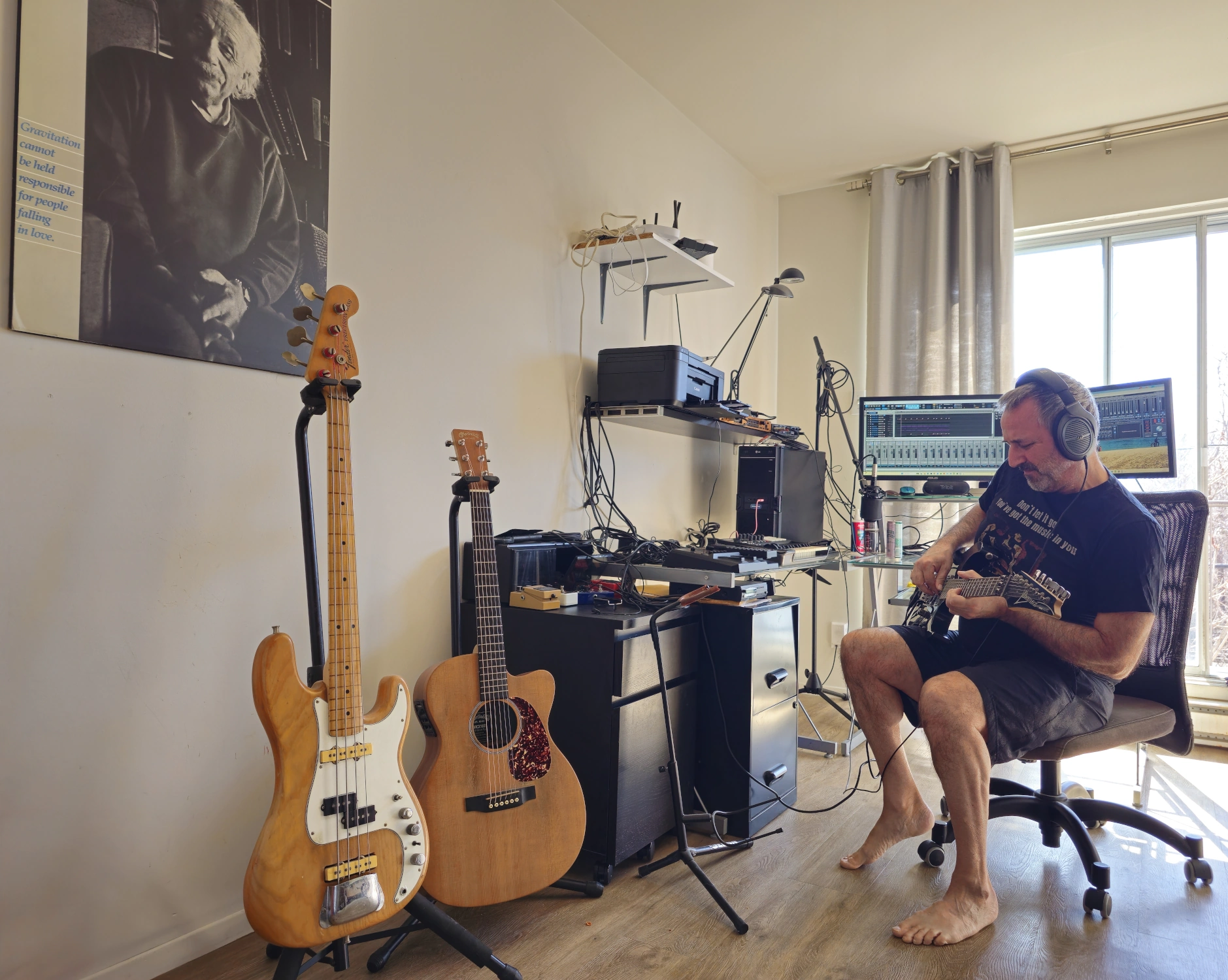
There’s something genuinely magical about creating music in the comfort of your own space. No studio clock ticking, no hourly rates pressing down on your creativity—just you, your instruments, and a world of sound waiting to be captured. After years of honing my craft, I decided to build my own personal musical portfolio, recording every note myself in my home recording studio. Today, I want to share not just the results of that journey, but the process behind it—because understanding how music gets made might just inspire you to create your own.
Every song you’ll hear at the end of this post represents hundreds of small decisions, technical experiments, and moments of pure creative flow. I’ve played every instrument, engineered every track, and shaped every sound. This isn’t just a collection of songs—it’s a window into what a dedicated hobbyist can achieve with the right tools, some patience, and a genuine love for music.
The Heart of My Setup: Sonar 3 Producer and VST3 Technology
Every great home recording studio needs a digital audio workstation (DAW) that can handle complex projects without overwhelming the user. For me, that foundation is Sonar 3 Producer x64—a powerful DAW that has become the creative engine behind everything I produce. What makes Sonar 3 particularly appealing is its robust support for VST3 (Virtual Studio Technology), which opens the door to an incredible universe of effects and virtual instruments.
Note : Cakewalk Sonar delivers a powerful digital audio workstation experience, now enhanced with upgraded features, improved performance, and a new access model. You can get started for free with the core version and you don’t need to subscribe to their membership to benefit of all the features of Sonar and adding any VST3 plugins.
VST3 plugins are the secret weapons in modern music production. Whether I need lush reverb to place a guitar in a virtual space, precise equalization to balance frequencies, or echo effects that add dimension to a vocal track, these virtual tools deliver professional results. The beauty of using VST3 in my home studio is that I can access the same kinds of effects that major recording studios use—without the massive investment. Reverb plugins can make an acoustic guitar sound like it’s in a concert hall, while compression VSTs help smooth out the dynamic range of a performance, ensuring nothing sounds too quiet or too loud.
The mixing and mastering process happens entirely within this digital environment as well. I can adjust volume levels, pan instruments left or right, add effects in parallel, and fine-tune every element until the song feels just right. It’s a deeply satisfying process—the musical equivalent of sculpting, where the raw material gradually takes shape into something beautiful.
Playing It Real: Live Instruments and Authentic Drum Tracks
One of the things that makes my personal musical portfolio distinct is that every instrument you hear was played live by me. I didn’t rely on pre-programmed loops or generic MIDI performances. Instead, I picked up each instrument and recorded my performances directly into the system. This includes bass guitar, acoustic and electric guitars, synthesizer and piano parts, and of course, vocals.
There’s an undeniable honesty in live performance that digital approximations often struggle to replicate. When I play a bass line, the subtle nuances of my finger placement, the slight variations in attack, the warmth of a particular moment—all of these human elements become part of the recording. The same applies to guitar solos, chord progressions, and melodic lines. These aren’t robotically perfect takes; they’re living, breathing musical expressions.
For drums, I took a hybrid approach that I believe offers the best of both worlds. I used SessionDrummer 3, a VST plugin that provides MIDI patterns originally recorded by real drummers. These aren’t the mechanical drum loops of decades past—these are sophisticated performances captured from actual drummers, then converted to MIDI. The result is rhythms that sound fluid, human, and musically intelligent. Of course, no technology is perfect, so I always adapt certain sections to fit my specific musical creations. Sometimes I’ll adjust the velocity of a snare hit, extend a fill, or shift a groove slightly to match the emotional arc of a particular song.
This approach gives me professional-sounding drum tracks while maintaining the creative control to shape them exactly as I envision. It’s one of the great advantages of building a home music studio—combining sophisticated tools with personal artistry.
SmartEQ4: AI-Powered Mixing and Mastering
Once all the tracks are recorded, the real artistry begins in mixing and mastering. This is where a collection of individual performances transforms into a cohesive song. For this crucial stage, I rely on Sonible SmartEQ4, a remarkable VST3 plugin that uses artificial intelligence to assist with equalization.
SmartEQ4 is genuinely impressive in its capabilities. The AI analyzes each track or the entire mix and suggests equalization settings based on the characteristics of the instrument or the overall sound. For example, when working with drum tracks, you might adjust any part of the frequency band by adding a dynamic filter around 60-80 Hz that give the kick drum that satisfying punch, or make a smooth boost around 3 kHz range that makes a snare crack through the mix with power and clarity.
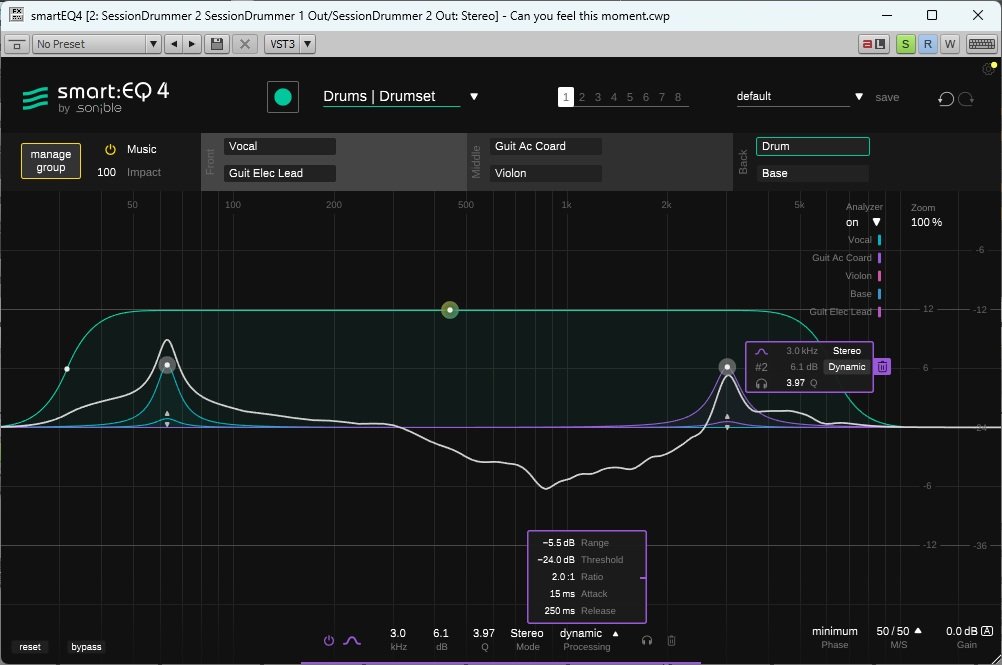
What I appreciate most about SmartEQ4 is that it doesn’t replace human judgment—it enhances it. The AI provides a excellent starting point, but I always have the freedom to adjust any part of the frequency band, add dynamic filters at specific frequencies, and shape the sound to match my artistic vision. This combination of artificial intelligence and human creativity produces results that truly stand alongside professionally mastered recordings.
Guitar Solos and the Circle of Fifths
Creating memorable guitar solos is both an art and a science. In my process, improvisation plays a major role—but it’s not random improvisation. I work within a structured framework that makes creative exploration feel natural rather than chaotic.
Most of my solo improvisations are built around the chord progression of a given song, which typically links to a single musical scale. Working within one scale simplifies the improvisational process considerably, because I know that every note I play will sound harmonious with the underlying harmony. This gives me the freedom to focus on expression, emotion, and melodic storytelling rather than worrying about hitting wrong notes.
When I need to find the perfect scale or determine which chords will work well together, I turn to the circle of fifths—a fundamental concept in music theory that has guided composers for centuries. The circle of fifths helps me identify key relationships, understand which scales share similar note profiles, and make informed choices about modulation or harmonic movement. It’s a tool that bridges mathematical precision and artistic intuition, and it’s helped me create guitar solos that feel both technically sound and emotionally resonant.
Mastering Your Instrument: The Path to Creative Freedom
Beyond the technical aspects of recording and production, there’s a deeper truth I’ve discovered through this journey: mastering your instrument is essential to expressing your true creative potential. This applies to anyone making music, regardless of whether they’re working in a professional studio or a humble home setup.
When you first learn an instrument, your mind is filled with technical concerns—where to place your fingers, how to hold the bow, when to breathe. These conscious thoughts create a barrier between your emotional intent and the sound you produce. But as you practice and develop fluency, something remarkable happens. The technical demands become second nature, freeing your mind to focus on something more profound: the feelings you want to convey.
This is why mastery matters. It’s not about playing faster or more technically complex passages—it’s about achieving a state where your instrument becomes an extension of your emotional self. When you reach that point, the whirlwind of distracting thoughts quiets, and you can channel your entire being into the music. It’s remarkably similar to other creative pursuits: athletes call it being “in the zone,” painters describe losing themselves in the canvas, and dancers talk about becoming one with the movement.
The instrument doesn’t matter—whether it’s guitar, piano, synthesizer, or your own voice. What matters is that you develop enough proficiency to stop thinking about technique and start thinking about expression. That transformation is where authentic creativity lives, and it’s what I’m constantly striving toward in my own musical journey.
I hope this glimpse into my home recording studio has inspired you to explore your own musical creativity. Whether you’ve been playing for years or are just curious about starting, there’s never been a better time to create music at home. The tools are accessible, the technology is remarkable, and the satisfaction of hearing your own compositions come to life is genuinely unparalleled.
If you’re curious to hear the results of this process, I invite you to explore my personal musical portfolio. Every track represents not just the final product, but the countless hours of practice, experimentation, and creative discovery that went into making it. Listen closely, and you might hear the story of someone who followed their musical passion—one note at a time.
Note: All of the audio files below are loaded only when you click the play button, in order to speed up page loading.