
The Myth of the Short Life Expectancy of Electric Car Batteries
Read time:

There’s a persistent whisper in automotive circles that electric vehicle batteries are ticking time bombs—devices doomed to lose their capacity within a few short years, leaving drivers stranded with expensive paperweights where their charging ports used to be. But here’s the surprising truth: the electric car battery lifespan is actually far longer than most people realize, and the science behind degradation is far more nuanced than the doom-sayers suggest.
Recent data from real-world studies shows that modern EV batteries lose only about 2-3% of their capacity per year under normal driving conditions—and that’s the worst-case scenario. Some batteries have proven capable of outlasting the cars themselves. So let’s dive into what’s really happening inside those battery packs, what factors accelerate degradation, and what innovations are poised to make today’s concerns tomorrow’s distant memories.
Understanding EV Battery Degradation: The Numbers Don’t Lie
At its core, EV battery degradation rate refers to the gradual loss of a battery’s ability to hold a charge over time. Think of it like the gradual slowing of a smartphone battery after a couple of years—except with far higher stakes and far more sophisticated engineering behind it.
Research from multiple sources, including fleet studies and independent analyses, reveals that most EV batteries today retain 70-80% of their original capacity after 200,000 to 300,000 miles of use. For the average driver covering 12,000-15,000 miles annually, that translates to 15-20 years of reliable service before any significant range reduction becomes noticeable.
The key phrase there is “under normal driving conditions.” Just as your grandmother’s gasoline car would suffer if you constantly revved the engine to redline, EV batteries respond poorly to certain types of stress. Understanding these stress factors is the first step toward maximizing your battery’s healthy lifespan.
The Cooling Factor: Why Your EV’s Climate Control Matters More Than You Think
One of the most critical—yet frequently overlooked—aspects of electric car battery cooling system types is how temperature management directly impacts longevity. Just as humans perform best at around 98.6°F, EV batteries have their own Goldilocks temperature range, typically between 60°F and 85°F. When batteries run too hot or too cold, degradation accelerates dramatically.
This is where the distinction between cooling systems becomes genuinely fascinating. Let’s examine the real-world data:
- Liquid cooling systems (used by Tesla and most premium manufacturers): These sophisticated systems circulate coolant—often a water-glycol mixture—through channels surrounding the battery cells. Studies show that vehicles like the Tesla Model S experience degradation rates of approximately 2.3% per year under typical use.
- Passive air-cooling systems (used by Nissan and some early EVs): These rely on airflow, either passive convection or forced fan systems. The Nissan Leaf, for instance, shows degradation rates around 4.3% per year in hotter climates.
The difference is striking: nearly double the annual capacity loss. Why such a dramatic gap? Liquid cooling maintains more consistent temperatures during charging (when batteries generate significant heat), highway driving, and extreme weather conditions. The coolant absorbs and dissipates thermal energy far more efficiently than air, keeping those precious lithium-ion cells operating in their optimal temperature window.
If you’re shopping for an EV and longevity is a priority, paying attention to the cooling system isn’t just nerdy technical curiosity—it’s practical wisdom. Look for vehicles with liquid cooling, especially if you live in regions with temperature extremes.
Charging Habits: The Buffers That Save Your Battery
Here’s something that might surprise you: your EV battery almost never actually uses its full theoretical capacity. Car manufacturers deliberately build in buffers—essentially reserved zones at the top and bottom of the charge spectrum—to protect against the most damaging charge states.
When your dashboard shows “100% charge,” the battery is actually sitting at around 90-95% of its physical maximum. Similarly, when it reads “0%” and the car gracefully limps to a stop, there’s usually 5-10% capacity remaining in the tank. These buffers exist precisely because running batteries to their absolute extremes—regularly charging to true 100% or draining to true 0%—significantly accelerates degradation.
This brings us to an important point about charging habits. While modern EVs handle these issues gracefully, there are still practices that can help or hinder your battery’s health:
- Avoid consistent 100% charges when unnecessary. If you don’t need maximum range for today’s trip, stopping at 80% is kinder to your battery.
- When possible, charge in moderate temperatures. Extreme heat or cold during charging puts additional stress on cells.
- Use scheduled charging if your EV offers it. This allows the battery management system to condition the cells to optimal temperatures before charging begins.
- Don’t fear public charging. While extremely fast DC charging (350kW+) generates more heat, occasional use is unlikely to cause meaningful harm to modern batteries.
Think of these buffers as the suspension system of your battery’s health—absorb the bumps, and the ride lasts longer.
The Rise of Battery Swap Technology: A Glimpse Into an Alternative Future
While most of us picture the standard plug-in charging experience, an intriguing alternative has been developing primarily in China: battery replacement stations. The most prominent player is NIO, a Chinese EV manufacturer that has built thousands of these stations across China and is now expanding into select European markets.
At a NIO battery swap station, drivers pull in, and in just 3-5 minutes, a robotic system removes the depleted battery and installs a fully charged one. It’s conceptually similar to the old refill days, but with zero emissions and zero wait time at the pump.
The advantages are particularly compelling for fleet operators and drivers covering high miles: batteries remain the property of the swap network, which maintains and replaces them as needed. You never own a degrading battery—you simply rent always-fresh capacity.
Whether this model achieves widespread adoption in Western markets remains to be seen, but it demonstrates that the EV industry isn’t putting all its eggs in one technological basket. Innovation is happening on multiple fronts simultaneously.
Types of EV Batteries: The Chemistry Behind the Capacity
Not all EV batteries are created equal. The chemistry inside your vehicle’s battery pack determines everything from range and charging speed to longevity and safety. Here’s a quick breakdown of the primary types:
- Nickel-Manganese-Cobalt (NMC): The most common chemistry in modern EVs, offering an excellent balance of energy density, power output, and lifespan. Used by Tesla, GM, and most European manufacturers.
- Iron Phosphate (LFP): Growing in popularity due to lower cost and improved thermal stability. Slightly lower energy density, but excellent longevity and safety. Tesla uses LFP in some Model 3 variants, and Chinese manufacturers have embraced it widely.
- Nickel-Cobalt-Aluminum (NCA): High energy density, primarily used by Tesla. Offers excellent range but requires sophisticated thermal management.
- Sodium-Ion: The newest commercial entrant. No lithium required, making it potentially far cheaper and more sustainable. Still in early production stages but showing promise.
Each chemistry has its trade-offs, and manufacturers select based on their priorities: maximum range, minimum cost, superior longevity, or balanced performance.
The Solid-State Revolution: What It Means for Future EVs
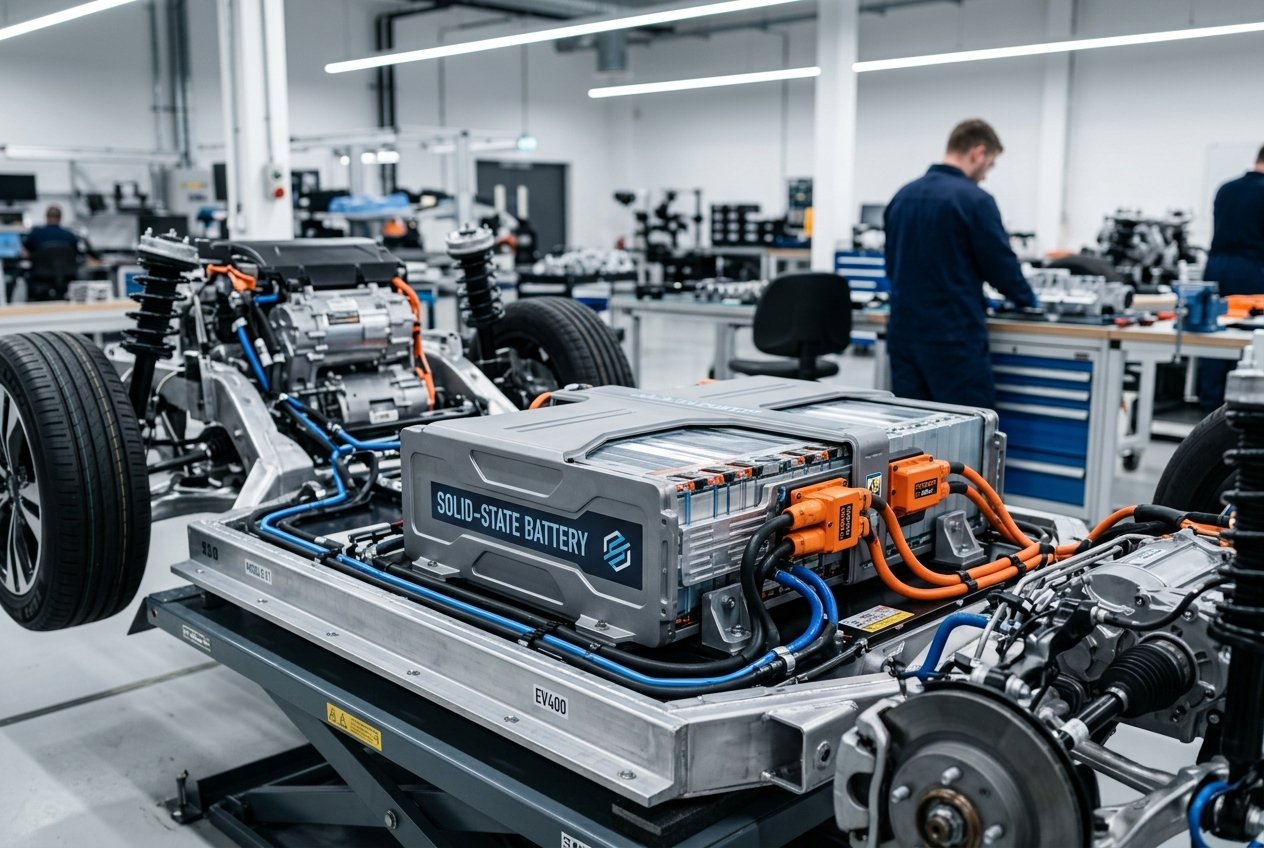
If there’s one technology poised to dramatically reshape the solid-state battery electric vehicle landscape, it’s—quite literally—solid-state batteries. These aren’t just incremental improvements; they represent a fundamental shift in how batteries work.
Traditional lithium-ion batteries use a liquid electrolyte—a substance that allows lithium ions to flow between the positive and negative electrodes. This liquid is flammable, limiting energy density and requiring robust cooling systems. Solid-state batteries replace this liquid with a solid electrolyte, which is far more stable and allows for dramatically higher energy densities.
The benefits are genuinely exciting:
- Potential for 10x energy density compared to current lithium-ion technology in laboratory settings, though real-world production is still emerging.
- Charging times under 10 minutes for significant capacity gains—effectively eliminating the “range anxiety” that concerns so many prospective EV buyers.
- Improved safety: Solid electrolytes are far less flammable than liquid variants, reducing thermal runaway risks.
- Longer lifespan: Solid electrolytes cause less degradation over charge cycles.
Major manufacturers including Toyota, Samsung, and QuantumScape are racing to bring solid-state batteries to market. Toyota has indicated plans for solid-state-powered vehicles by 2027-2028, and the technology could reshape everything we know about EV range and charging.
Giving Batteries a Second Life: The Recycling Revolution
Here’s a truth that might surprise you: recycling electric vehicle batteries is already a well-established industry, despite the technology being relatively young. The processes are sophisticated, the recovery rates are impressive, and the environmental logic is undeniable.
Two primary recycling methods dominate the industry:
- Hydrometallurgy: Batteries are submerged in chemical baths that dissolve and separate precious metals like lithium, cobalt, and nickel. This method can recover up to 95% of materials and is particularly safe and efficient.
- Pyrometallurgy: Batteries are melted at extremely high temperatures, separating metals from other materials. This approach is well-suited for handling mixed waste streams.
The concept of an “urban mine”—recovering precious minerals from discarded electronics and vehicles rather than mining new materials—is gaining serious traction. Companies like Li-Cycle (now owned by Glencore Canada) are building massive recycling facilities, while Lithion Technologies in Quebec has developed a patented hydrometallurgical process that sets new standards for efficiency and safety.
In China, where most EV batteries are manufactured, giants like CATL and BYD dominate recycling efforts, benefiting from strong government support and integrated supply chains. The environmental implications are significant: recycling reduces the need for new mineral extraction, lowers carbon emissions, and creates a more sustainable closed-loop system for the EV industry.
What’s Next? The Innovations Shaping 2025 and Beyond
The EV battery landscape is evolving at a breathtaking pace. Here’s what’s emerging on the horizon:
- Semi-solid-state batteries: A transitional technology already entering mass production, offering improved energy density and safety without the full manufacturing challenges of pure solid-state.
- Sodium-ion batteries: CATL has already announced sodium-ion packs capable of 11-minute charging—remarkable given the technology’s lower material costs.
- Silicon anodes: Silicon can store far more lithium than traditional graphite anodes, dramatically increasing energy density. Several manufacturers are introducing silicon-dominant anodes in 2025-2026.
- Extreme low-temperature batteries: New chemistries designed to maintain performance in frigid conditions, addressing a historic weakness of lithium-ion technology.
- Wireless charging: Inductive charging infrastructure is expanding, potentially allowing EVs to charge while parked or even while driving on specially equipped roads.
- Battery passports: Regulatory requirements in Europe will soon mandate detailed tracking of battery origin, composition, and lifecycle—improving transparency and recycling efficiency.
The future of EV batteries isn’t just promising—it’s already arriving faster than most industry observers predicted.
Frequently Asked Questions
How long do electric car batteries actually last?
Most modern EV batteries are designed to last between 10-20 years before falling below usable capacity thresholds. Real-world data shows batteries typically retain 70-80% capacity after 200,000-300,000 miles, with some exceeding 500,000 miles with minimal degradation.
Which EV battery degrades the slowest?
Based on available data, vehicles with liquid cooling systems (like Tesla models) show the slowest degradation—around 2.3% annually—compared to air-cooled systems like the Nissan Leaf at 4.3% annually. Within the Tesla lineup, models using LFP chemistry (like certain Model 3 variants) tend to show even slower degradation rates.
Is solid-state battery technology ready for mainstream EVs?
Solid-state batteries are currently in late development and early pilot production phases. Toyota and other manufacturers plan limited deployments around 2027-2028, with wider adoption expected in the early 2030s. Semi-solid-state technology is already entering production as a bridge technology.
Does fast charging damage EV batteries?
Occasional fast charging causes minimal degradation in modern EVs with sophisticated thermal management. However, frequent extreme fast charging (350kW+) can accelerate degradation somewhat due to increased heat generation. For daily charging, Level 2 home charging is gentlest on batteries.
What happens to EV batteries when they can no longer power a car?
When EV batteries fall below approximately 70-80% capacity for automotive use, they enter a “second life” phase. These batteries can still store significant energy and are often repurposed for grid storage, home energy systems, or backup power applications. When second-life applications are no longer viable, the batteries are fully recycled, recovering up to 95% of valuable materials.
Conclusion: The Battery Story Is Just Beginning
The narrative that electric car batteries are fragile, short-lived, and problematic simply doesn’t hold up to scrutiny. Yes, they require proper care—like any sophisticated technology. Yes, extreme conditions and charging habits can influence degradation. But the data is clear: electric car battery lifespan routinely exceeds a decade of reliable service, and the technology continues to improve at a remarkable pace.
If you’re considering an EV, don’t let battery anxiety hold you back. Look for vehicles with liquid cooling systems, develop sensible charging habits (those buffers exist for a reason), and understand that the battery will likely outlast the rest of the car. And if you’re an existing EV owner, rest easy: the billions being invested in solid-state technology, recycling infrastructure, and energy density breakthroughs mean that today’s concerns are tomorrow’s solved problems.
The electric future isn’t coming—it’s already here, and the batteries are far more resilient than the skeptics would have you believe.