How TinyML and Optical AI Are Quietly Revolutionizing Biodiversity & Forestry Monitoring?
Read time:

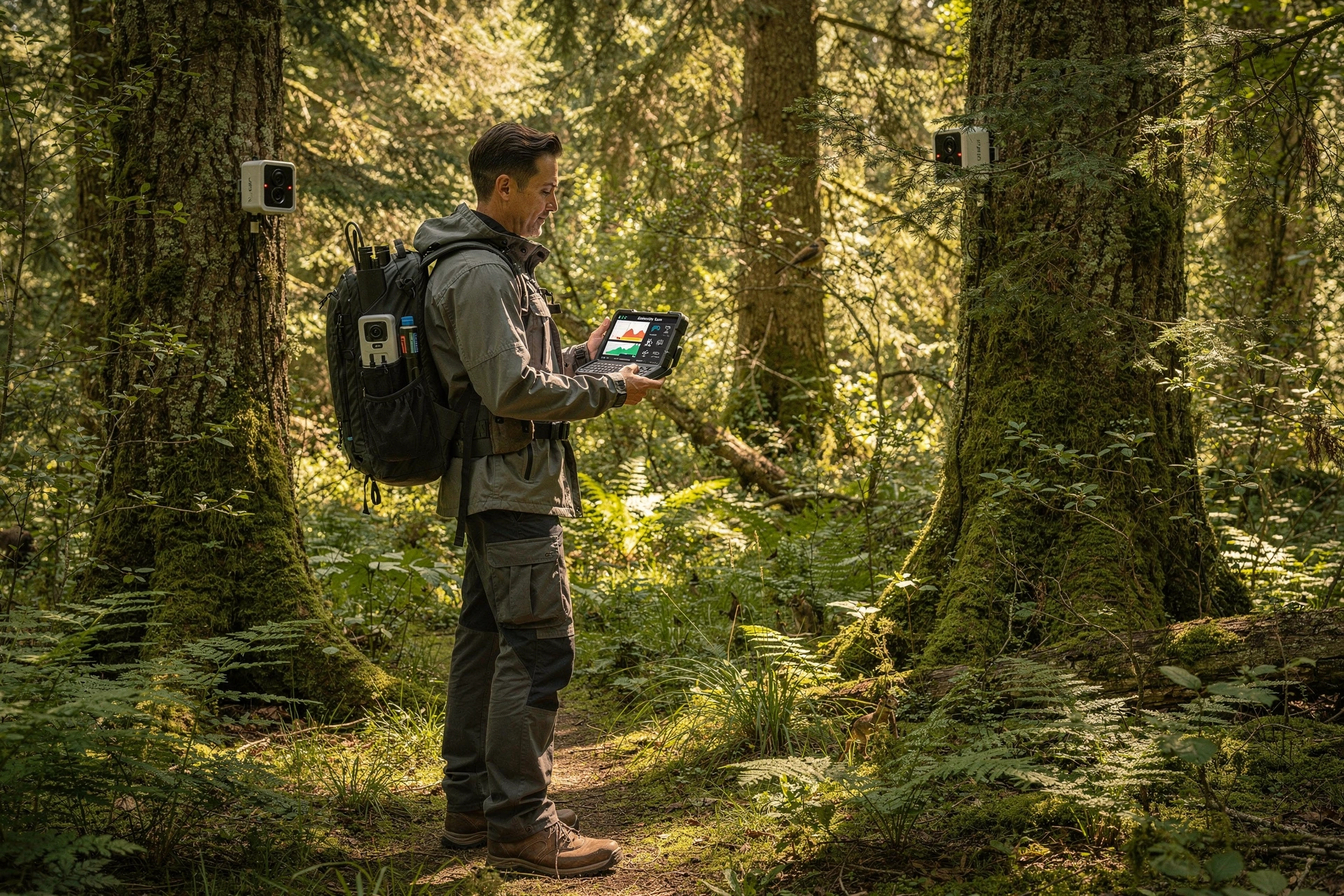
Imagine a tiny solar-powered sensor no bigger than a deck of cards, perched on a rain-soaked branch deep in the Amazon. It listens, watches, and thinks — independently identifying a rare bird call, detecting the acoustic signature of an illegal chainsaw, and logging a jaguar’s thermal silhouette, all without sending a single byte to the cloud. No satellite uplink. No human on-site. Just raw, real-time ecological intelligence, processed right where the data was born. That’s not science fiction. That’s TinyML biodiversity monitoring in action — and it’s already reshaping how we understand, protect, and manage the natural world.
We are living through a biodiversity crisis that moves faster than our traditional monitoring tools can keep pace with. Species are disappearing at rates estimated to be 1,000 times higher than natural background extinction levels, according to the World Wildlife Fund. Meanwhile, deforestation claimed roughly 4.7 million hectares of primary tropical forest in 2023 alone. The data collection methods we’ve relied on — field surveys, satellite imagery reviewed days later, or camera traps that require physical retrieval — are simply too slow, too expensive, and too geographically limited to match the scale of the challenge. Enter a new generation of AI edge devices for wildlife tracking and machine vision tools that are small enough to deploy at scale, smart enough to make autonomous decisions, and power-efficient enough to run for months on a battery or a tiny solar panel.
What Exactly Is TinyML — and Why Does It Matter for Ecology?
TinyML stands for Tiny Machine Learning — the practice of running machine learning inference models directly on microcontrollers and low-power processors with very limited computational resources. We’re talking about devices with as little as 256 kilobytes of RAM and processors running at under 100 megahertz. For context, that’s thousands of times less powerful than a modern smartphone. Yet through clever model compression techniques like quantization, pruning, and knowledge distillation, researchers have managed to pack surprisingly capable neural networks into these tiny chips.
Why does this matter for ecology? Three reasons: cost, connectivity, and speed. Deploying hundreds or thousands of sensors across a vast forest ecosystem would be cost-prohibitive if each device required high-end hardware. The remote locations where biodiversity is richest often have zero cellular or internet coverage, making cloud-dependent AI systems useless. And when it comes to detecting a poacher or identifying a wildfire’s early smoke signature, latency matters — you need a decision in milliseconds, not the minutes or hours it takes to upload data, process it remotely, and return a result.
TinyML solves all three problems simultaneously, and the forestry and conservation communities are taking serious notice. The global TinyML market was valued at approximately $1.1 billion in 2022 and is projected to exceed $11 billion by 2030, with environmental monitoring emerging as one of the fastest-growing application verticals.
TinyML: Tiny Machine Learning
Optical AI: The Eyes in the Forest
Optical AI forest monitoring refers to the use of computer vision algorithms — running either on edge devices or in lightweight embedded systems — to analyze visual data from cameras, multispectral sensors, and even LiDAR units mounted in forest environments. These systems can identify plant species from leaf morphology, detect early signs of disease or pest infestation in tree canopies, monitor soil disturbance patterns consistent with illegal logging, and even track animal movement through dense vegetation where traditional GPS collaring is impractical.
How Optical AI Works in Practice
At its core, an optical AI system deployed in a forest environment typically consists of a camera module (sometimes multispectral or infrared-capable), a low-power processor running a compressed convolutional neural network (CNN), and a small communication module for intermittent data transmission when connectivity allows. The CNN is pre-trained on large labeled datasets of plant species, animal silhouettes, or human activity patterns, then compressed and deployed to the edge device.
When the camera captures an image — triggered by a passive infrared motion detector or captured at scheduled intervals — the onboard CNN classifies what it sees in real time. Is that a tapir or a feral pig? Is that smoke or morning mist? Is that footprint pattern consistent with human foot traffic in a protected zone? The device makes the determination locally, logs the event with a timestamp and GPS coordinate, and either stores it for batch transmission or immediately sends a compact alert over a LoRaWAN or satellite link if the classification warrants urgent action.
Forest Monitoring Platforms:
- By Satellite:
EOS DATA ANALYTICS - By Drone
MORFO - Global Forest Map
Global Forest Watch
Forestmap AI
Species Identification at the Edge
One of the most exciting frontiers in machine learning species identification edge computing is the ability to identify individual animals — not just species — using biometric signatures like stripe patterns in zebras, whisker spot configurations in big cats, or fin shapes in cetaceans. Projects like Wildlife Insights (powered by Google AI) have demonstrated that camera trap images can be auto-classified with over 80% accuracy at the species level. The next evolution is running those same models directly on the camera trap hardware, eliminating the need for any data transfer at all until a human review is warranted.
Similarly, acoustic monitoring has seen remarkable progress. BirdNET, developed by the Cornell Lab of Ornithology and Chemnitz University of Technology, is a neural network model specifically designed to run on edge hardware and identify bird species from audio recordings. In field tests, it achieved over 75% accuracy across more than 3,000 bird species — running on a Raspberry Pi with no internet connection. Scaling this concept to the kind of ultra-low-power microcontrollers used in TinyML biodiversity monitoring deployments is now an active area of research, with several teams reporting successful sub-100KB acoustic classifiers capable of identifying dozens of species with acceptable accuracy.
Species Monitoring Platforms:
- Wildlife Insights powered by Google AI
- Goggle DeepMind: Mapping, modeling, and understanding nature with AI
- BirdNET Cornell to identify bird species from audio recordings
Note: Connection can be block. - Globil Panda
Real-Time Ecological Monitoring: From Concept to Deployable Reality
Real-time ecological monitoring AI isn’t just about speed — it’s about shifting the entire paradigm of conservation science from reactive to proactive. Traditional monitoring generates data that scientists analyze weeks or months after collection, producing insights that inform next year’s management plan. Real-time edge AI generates actionable intelligence the moment something ecologically significant happens.
Forest Fire Early Warning Systems
One of the most immediately impactful applications is wildfire detection. Optical AI systems mounted on fire towers or deployed as autonomous ground sensors can detect smoke plumes and abnormal thermal gradients minutes after ignition — long before the fire becomes visible from satellite. Dryad Networks, a Berlin-based startup, has deployed a solar-powered mesh network of edge AI sensors across forests in Europe that can detect the gaseous chemical signature of a fire (elevated CO, H₂, and ethanol levels) and the visual signature simultaneously, triggering alerts within 30 minutes of ignition — compared to the average 2-4 hours it takes satellite systems to detect and report a new fire.
Illegal Logging and Poaching Detection
Rainforest Connection (now part of Rainforest Alliance) pioneered the use of upcycled Android phones mounted in forest canopies to listen for chainsaws and logging trucks. Their Arbimon AI platform processes audio in real-time and has helped rangers intercept illegal logging operations across Peru, Ecuador, and Indonesia. The newer generation of purpose-built edge AI devices takes this further — adding visual confirmation, longer battery life, and more robust species-level acoustic classification. In one documented case in Sumatra, an edge AI audio monitoring network detected chainsaw activity and triggered a ranger response that arrived on-scene within 45 minutes, resulting in equipment seizure and arrests.
Phenology and Climate Change Tracking
Phenology — the study of cyclical biological events like flowering, migration, and hibernation — is one of the most sensitive indicators of climate change impacts on ecosystems. Edge AI camera systems can autonomously monitor and log first-bloom dates, migration arrival and departure times, and seasonal changes in canopy density across thousands of monitoring points simultaneously, generating phenological datasets of unprecedented spatial and temporal resolution. This kind of data, aggregated across years, will be invaluable for modeling climate change impacts on biodiversity and informing conservation prioritization decisions.
AI Edge Devices for Wildlife Tracking: Hardware Highlights
The hardware ecosystem for AI edge devices wildlife tracking has matured dramatically in the past three years. Here are some of the key platforms enabling this revolution:
- Arduino Nano 33 BLE Sense: A thumb-sized microcontroller with built-in IMU, microphone, and BLE connectivity. Widely used in acoustic species monitoring prototypes. Supports TensorFlow Lite Micro models up to about 250KB.
- Sony Spresense: A compact, low-power board with a built-in GNSS receiver and support for multi-microphone arrays, purpose-built for audio AI applications in remote environments.
- Google Coral Edge TPU: A dedicated ML accelerator that can run inference on compressed vision models at up to 4 TOPS (Tera Operations Per Second) while drawing just 2 watts — enabling real-time image classification on battery-powered camera traps.
- STMicroelectronics STM32 series: The workhorse of the TinyML world, used in countless commercial and research deployments for its balance of processing power, energy efficiency, and cost.
- Raspberry Pi + Hailo-8 AI accelerator: A slightly higher-power combination used when more sophisticated visual analysis is required, such as individual animal re-identification or complex behavioral monitoring.
These platforms are increasingly being paired with LoRaWAN communication modules for long-range, low-power data transmission to forest-edge gateways, and with satellite modems like the Swarm Tile for truly off-grid deployments in the most remote ecosystems.
Challenges and Honest Limitations
It would be intellectually dishonest to paint this technological revolution as entirely without friction. There are real, significant challenges that the field is actively working to address.
Model Accuracy in the Wild
Machine learning models trained on curated laboratory or structured field datasets often perform significantly worse when deployed in real-world conditions — a problem called distribution shift. A bird call classifier trained on clean audio recordings may struggle with overlapping species calls, wind noise, or rain. An optical AI model trained on standard daylight images may fail dramatically with night-vision infrared images. Addressing this requires diverse, high-quality training datasets collected in conditions that match deployment environments — a resource-intensive undertaking that demands ongoing investment.
Hardware Durability
Forest environments are brutally hostile to electronics. Humidity, temperature swings, insects, fungi, and curious animals (monkeys have a documented fondness for dismantling research equipment) all take their toll. Designing devices that can survive 6-12 months unattended in tropical or boreal forest conditions requires significant engineering investment and drives up unit costs.
Data Sovereignty and Indigenous Rights
Deploying monitoring networks in forests that are home to or traditionally managed by Indigenous communities raises important ethical questions about who owns the ecological data being generated and how it is used. Conservation technologists are increasingly recognizing that genuine community partnership is not just ethically necessary but practically essential — local communities often have irreplaceable ecological knowledge that dramatically improves model training and deployment, and their buy-in is critical for long-term system maintenance and protection.
Actionable Advice: How Conservation Organizations Can Get Started
If you’re a conservation practitioner, researcher, or NGO leader interested in deploying TinyML or optical AI in your work, here’s a practical roadmap:
- Start with a clearly defined monitoring objective. “Monitor biodiversity” is too broad. “Detect the presence/absence of three target mammal species at 20 camera trap locations with 48-hour data latency” is actionable and testable.
- Audit your existing data assets. Do you have labeled training data for the species or events you want to detect? If not, building or accessing a quality labeled dataset is your first priority — before any hardware procurement.
- Prototype before you scale. Test 5-10 devices in field conditions before committing to a large-scale deployment. Edge AI systems almost always require site-specific calibration and model fine-tuning that you can only discover through real-world testing.
- Engage the TinyML for Good community. Organizations like the TinyML Foundation and academic groups at MIT, ETH Zurich, and Makerere University have active programs supporting conservation applications of edge AI, including free technical assistance and model libraries.
- Plan your data pipeline holistically. Edge AI generates much less raw data than traditional sensor systems, but you still need a plan for aggregating, visualizing, and acting on the alerts and classifications your system generates. A beautifully engineered edge AI sensor is wasted without a usable dashboard and clear alert protocols on the human side.
- Budget for iteration. First-generation deployments will have failures — models that misclassify, hardware that fails, communication links that drop. Build financial and timeline contingency for at least two rounds of refinement before expecting production-quality performance.
The Numbers That Should Make You Pay Attention
The conservation case for investing in real-time ecological monitoring AI becomes even clearer when you look at the economics. Traditional field-based biodiversity monitoring programs in tropical forests can cost $50,000–$200,000 per year per monitoring site when you factor in personnel, travel, and data processing. A TinyML sensor network covering the same geographic area can be deployed for $5,000–$30,000 in hardware costs, with ongoing operational costs an order of magnitude lower. Meanwhile, the spatial and temporal resolution of data generated is dramatically higher — continuous monitoring versus quarterly field visits.
A 2023 analysis by Conservation Technology Alliance estimated that AI-augmented monitoring networks could reduce the per-hectare cost of comprehensive biodiversity surveillance by 60–80% compared to traditional approaches, while simultaneously increasing taxonomic coverage and monitoring frequency. At a time when conservation funding is chronically insufficient relative to need, that efficiency gain isn’t a nice-to-have — it’s a paradigm-shifting opportunity.
Frequently Asked Questions
Can TinyML devices really work without any internet connection?
Yes — this is actually one of TinyML’s defining strengths. The entire inference process (receiving sensor input, running the neural network, producing a classification or detection result) happens entirely on the device’s local processor. Internet or cellular connectivity is only needed if you want to transmit results remotely. Many deployments operate in fully offline mode for weeks or months, storing results locally until a field team retrieves the device or until it comes within range of a low-power wide-area network gateway.
How accurate are AI species identification systems running on edge devices?
Accuracy varies significantly depending on the species group, the quality of training data, and the sensor modality. Best-in-class acoustic bird identification systems running on edge hardware achieve 70–85% species-level accuracy across large species lists. Visual mammal identification systems on camera traps typically achieve 75–90% accuracy at species level, dropping to 50–70% for individual re-identification. These numbers continue to improve rapidly as training datasets grow and model architectures are refined for edge deployment constraints.
What connectivity options are available for truly remote forest deployments?
The primary options are LoRaWAN (range up to 15km line-of-sight, very low power, low data rates), Iridium or Swarm satellite modems (global coverage, higher cost per message, moderate power draw), and acoustic underwater modems for marine applications. For most terrestrial forest deployments, a hybrid approach works well: edge AI devices store classified events locally and transmit compact summary data via LoRaWAN to a gateway at the forest edge, which then uses cellular or satellite to forward alerts to conservation staff.
What are the biggest barriers to wider adoption of these technologies?
The three most significant barriers are: (1) the technical expertise required to train, compress, and deploy custom ML models, which is still beyond the capacity of most conservation organizations without specialized partnerships; (2) the lack of large, publicly available labeled training datasets for many species groups and geographic regions; and (3) the ongoing hardware cost and durability challenges for truly long-term, large-scale deployments in harsh environments. All three are areas of active investment and improvement.
The Future Is Already Growing in the Forest
The convergence of TinyML, optical AI, and low-power edge computing isn’t a future technology roadmap — it’s a present-tense transformation already underway in forests, wetlands, and marine ecosystems around the world. From the acoustic sentinels listening for chainsaws in Borneo to the optical AI cameras cataloging pollinators in Swiss alpine meadows, the infrastructure for a truly real-time, planetary-scale biodiversity monitoring network is being assembled, one edge device at a time.
What’s needed now is not more proof of concept — it’s scale, standardization, and sustained investment. Conservation organizations, governments, technology companies, and research institutions all have a role to play. If you’re working in conservation technology, ecological research, or environmental policy, the tools to fundamentally transform how humanity monitors and protects the living world are available today — and the cost of waiting is measured not in dollars, but in species. Now is the time to deploy, learn, iterate, and scale. The forest is already listening. It’s time we listened back — smarter, faster, and at every corner of the wild world that needs our attention.