
How Much Does It Cost to Charge an EV vs. Fill a Gas Tank in 2026?
Reading time:
7 min read
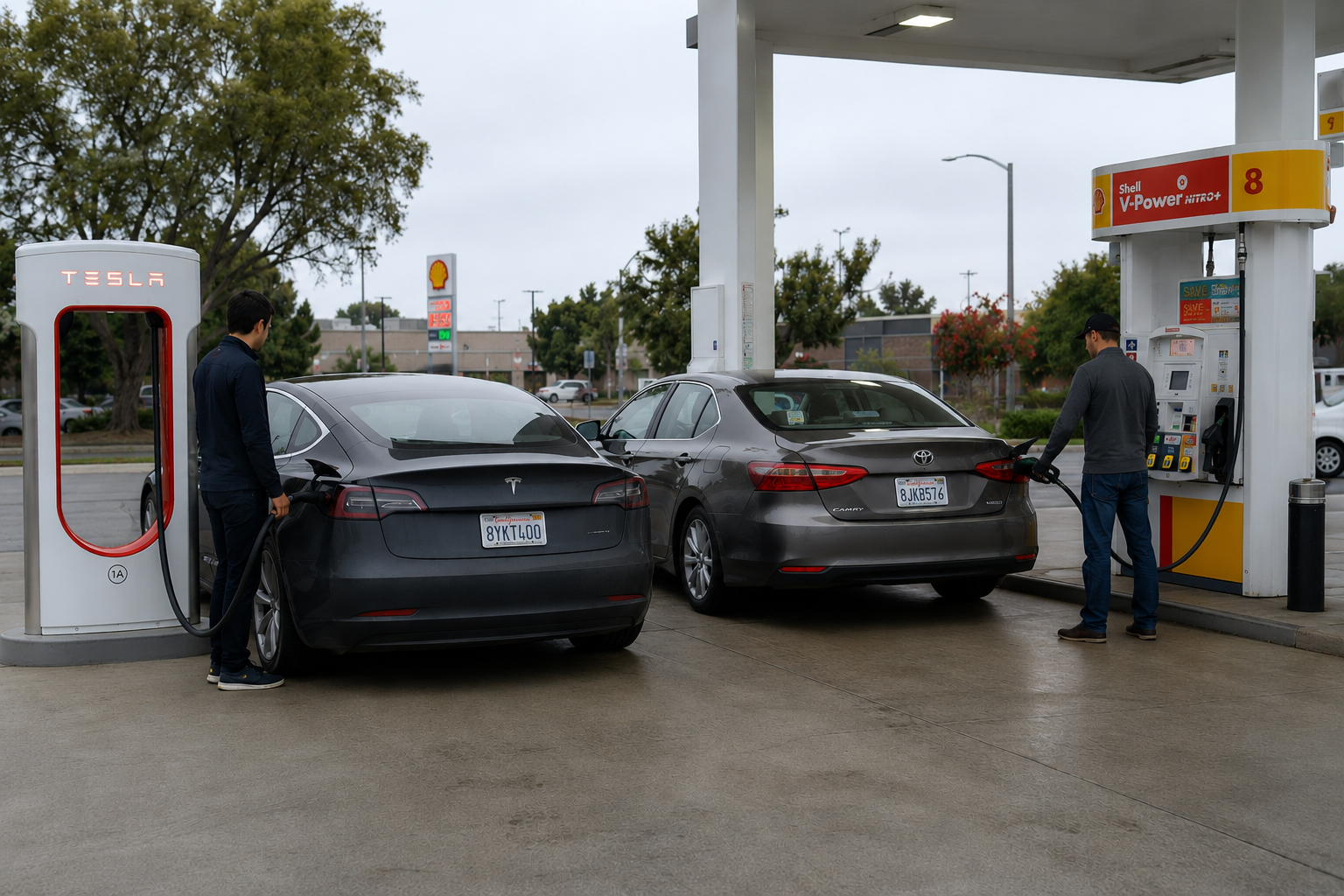
Picture this: for over a century, we’ve all nodded knowingly at the gas pump, eyeing those dollars per gallon like an old friend—or foe. That simple metric dictated road trips, family budgets, and even where we built our neighborhoods. But enter the electric vehicle (EV), and suddenly we’re talking kilowatt-hours instead of gallons. It’s like comparing apples to electron flows. So, how much does it cost to charge an EV vs. gas In 2026?, the answer isn’t a flat number—it’s a spectrum that hinges on where, when, and how you plug in. Stick with me, and we’ll unpack this with real numbers, no smoke and mirrors, to help you decide if ditching the pump for the plug makes sense for your driveway.
By 2026, with battery tech advancing and grids greening up, the average EV sips electricity at 0.04–0.18 per mile for home chargers, or up to 0.12–0.24 per mile if you’re hitting public stations. That’s potential yearly savings of $600–1,200 for the typical driver—but only if home charging is your norm. Public fast charging? It can flip the script faster than a bad U-turn. Let’s dive in, shall we? We’ll compare EV charging costs vs. gas head-to-head, with tables, scenarios, and math you can trust.
Note: 1 mile = 1,60934 km
The Three Ways People Charge EVs and Why Your Choice Defines the Savings
Unlike gas, where you pull up and pay the same price everywhere (give or take a nickel), EV charging is a choose-your-own-adventure tale. Home setups, public Level 2, or DC fast chargers each carry wildly different price tags. In 2026, electricity rates have stabilized post-inflation spikes, but time-of-use pricing and location still rule the day. Here’s the breakdown:
| Charging Type | Cost (USD) per kWh in 2026 | Efficiency Loss | Real-World Cost (USD) per 100 m / 161 Km |
|---|---|---|---|
| Home (off-peak) | $0.12–$0.18 | ~10% | $4.00–$6.00 |
| Home (peak) | $0.22–$0.30 | ~10% | $7.30–$10.00 |
| Public Level 2 | $0.20–$0.35 | ~5% | $6.30–$11.00 |
| DC Fast Charging | $0.40–$0.60 | ~5% | $13.30–$20.00 |
Notice that eye-popping spread? From $4 to $20 per 100 miles/160Km—that’s the gulf between fueling up for the price of your morning latte or a quick fast-casual lunch. Home off-peak charging turns your EV into a budget superhero, leveraging nighttime rates when the grid yawns and utilities discount. But if you’re apartment-dwelling or road-tripping, public options bite harder. Pro tip: Install a Level 2 home charger (costs $500–$1,500 installed in 2026) and time it right. It’s the single biggest lever for EV vs. gas cost savings.
Statistics back this up: According to the U.S. Department of Energy’s 2025 projections extended to 2026, 70% of EV owners charge primarily at home, reaping 40–60% lower costs per mile than gas equivalents. Yet, for the 30% relying on public infrastructure, savings shrink to 10–20%. It’s reassuring to know the tech works—the nuance is in your lifestyle.
Side-by-Side Showdown: Three Popular EVs vs. Three Gas Stalwarts
Enough theory—let’s pit real vehicles against each other. We’ll assume home charging at a friendly $0.15/kWh for EVs and a national average gas price of $3.50/gallon (per EIA 2026 forecasts). These models are searchable favorites: efficient, practical, and what folks your age might eye for the next family hauler or daily driver.
| Vehicle | Fuel Type | Efficiency | Cost (USD) per 100 m / 160 Km | Annual Cost (USD) (12k m / 19.2k Km) |
|---|---|---|---|---|
| Tesla Model 3 RWD | EV (home) | 3.5Mi-5.6Km /kWh | $4.29 | $514 |
| Hyundai Ioniq 6 | EV (home) | 3.8Mi-6.09Km /kWh | $3.95 | $474 |
| Chevy Equinox EV | EV (home) | 3.0Mi-4.80Km /kWh | $5.00 | $600 |
| Toyota Camry | Gas | 33 MPG – 59km | $10.61 | $1,273 |
| Honda CR-V | Gas | 30 MPG – 48km | $11.67 | $1,400 |
| Ford F-150 | Gas | 21MPG – 33.6km | $16.67 | $2000 |
The verdict? EVs crush it at home: $700–$1,500 annual savings versus comparable gas cars. That Tesla Model 3? It pays for itself in fuel alone after 5–7 years for many buyers. But—and this is the clever catch EV boosters sometimes gloss over—swap in public fast charging, and poof! The math wobbles. Your garage is the secret sauce.
Why These Models Matter for You
Chosen for relevance: The Model 3 is the EV sales king, Ioniq 6 nabs efficiency crowns, Equinox EV hits SUV sweet spots. Gas counterparts? Reliable workhorses like the Camry (America’s bestseller) and CR-V (crossover champ). In 2026, with incentives fading, these reflect real-world choices for 40–70-year-olds prioritizing comfort over flash.
When the EV Advantage Vanishes: Fast Charging and Road Trip Realities
EV headlines scream savings, but let’s get real with two scenarios where gas pulls ahead—or ties.
- Scenario 1: Full-Time Public Fast Charging
At $0.50/kWh DC fast rates (common at Electrify America or EVgo in 2026), a Tesla Model 3 jumps to $14.30 per 100 miles/160km. That’s pricier than the Camry’s $10.61 and neck-and-neck with the CR-V’s $11.67. If work or apartments force this, rethink the switch. - Scenario 2: Cross-Country Road Trips
A 500-mile/800km haul on fast chargers? Roughly $70 in electricity. Same in a Camry? $53 in gas. Add wait times and range anxiety, and the “convenience” premium stings.
This isn’t doom for EVs—they shine as daily drivers. But for snowbirds or frequent flyers (er, drivers), hybrids might bridge the gap. We’re in transition: By 2030, fast charger prices could drop 20–30% with scale, per BloombergNEF. Patience pays.
Real-World Math: Crunching 15,000 Miles / 24,140 km Per Year
Let’s personalize it. Assume 15,000 miles / 24 140 km annual (U.S. average plus a bit), 80% home charging at $0.15/kWh, 20% fast at $0.50/kWh. EV: 3.5 mi/kWh (Model 3). Gas benchmark: 30 MPG CR-V at $3.50/gal.
EV Breakdown:
- 12,000 miles / 19,312 Km home: (12,000 / $3.5) * 1.10 (efficiency loss) * $0.15 = $514
- 3000 miles/4828 Km fast: (3,000 / $3.5) * 1.05 * $0.50 = $429
- Total EV: $943
Gas Breakdown:
15,000 miles / 30 MPG = 500 gallons * $3.50 = $1,750 USD
Here is the same result for those who would like to see it in kilometers.
15,000 miles * 1.60934 = 24140 km
Convert Fuel Efficiency to km/L (Must multiplying by 0.42514)
30 mpg * .42514 = 12.754 km/L
Convert Total Fuel to Liters (1 Gallon = 3.7854 Liters so 500 gallons * 3.78541 = 1892 Liters)
24140 km / 12.754 km/L = 1,892 Liters * ($3.5/3.7854 L) $0.92460 = $1.749 USD
Savings: $807/year. Over five years? $4,035—enough to offset a chunk of that EV premium (now $5,000–$8,000 post-incentives). But flip to 100% fast charging? EV hits $2,143/year. Suddenly, gas wins. The math is yours to own.
The Ultimate Table: Cost Per Mile by Charging Mix
| Charging Mix | EV Cost (USD) per miles / 1.6km | Gas Cost (USD) per mile (30 MPG-7.85L/100km) | EV Saves (USD) |
|---|---|---|---|
| 100% home (off-peak) | $0.043 | $0.117 | $0.074/mile |
| 80% home / 20% fast | $0.063 | $0.117 | $0.054/mile |
| 50% home / 50% fast | $0.100 | $0.117 | $0.017/mile |
| 100% fast charging | $0.143 | $0.117 | -$0.026/mile (gas cheaper) |
Visualize your blend:
Break-even at ~70% home charging. Above? EVs dominate. Below? Gas edges out. Infrastructure is king—for wallet and planet (grid emissions vary wildly by state).
Regional Variations: Electricity and Gas Prices by State
Costs aren’t uniform. In sunny California, off-peak home rates dip to $0.10/kWh, amplifying savings. North Dakota? Gas at $3.20/gal but electricity at $0.25/kWh peak. Here’s a quick 2026 snapshot:
- Low EV Cost States: WA, OR, NY (cheap hydro/nuclear power: $0.11–$0.15/kWh off-peak).
- High EV Cost States: CA peak ($0.35+), HI ($0.40+).
- Gas Havens: OK, TX ($3.00/gal avg.) favor trucks.
Check your utility app or GasBuddy. Tools like PlugShare forecast your blend accurately.
ChargeHub App in Canada
Actionable Advice: Minimize Your EV Charging Costs
- Go Home Heavy: Install a 240V Level 2 charger. Rebates via IRA still flow in 2026—up to $1,000 federal. In Canada the average Rebate is between $300 to $600 CAD in 2026. Canada Charger Rebate Guide
- Time It: Apps like Ohme or utility portals schedule off-peak (often midnight–6 AM).
- Public Smarts: Use Electrify America Pass+ for 20–30% discounts; avoid peak hours.
- Road Trip Hack: Plan via A Better Routeplanner—mix Level 2 overnight hotels ($0.20/kWh) with fast stops.
- Tax Perks: Business-use EVs deduct $0.30/mile equivalent in electricity (vs. $0.67 gas).
- In Canada FLO Network and Electrify Canada Members can get discounted charging rates by subscribing to their monthly Pass+ plan membership accounts.
These steps can boost savings 20–40%. Warm note: Start small—lease an EV to test without commitment.
FAQs: Your Burning Questions on EV Charging Cost vs. Gas
How much does it cost to charge an EV at home in 2026?
$0.12–$0.30/kWh, or $4–$10 per 100 miles. Cheaper than gas 80% of the time.
Is EV cheaper than gas for daily commuting?
Yes, if home-charging: 50–70% less per mile. 12,000 miles/year? $500–$700 saved.
What about winter? Does cold kill EV efficiency?
Expect 20–30% range hit, raising effective costs 25%. Preheat via app to mitigate.
Public charging apps and networks?
Electrify America, ChargePoint, EVgo. Subscriptions save 15–25%. For Canadien you can Locate free charging stations and get Charging Station Information with the ChargeHub App
Future outlook: Will fast charging get cheaper?
Yes—projected 25% drop by 2030 as stations proliferate (500k+ U.S. by then).
Beyond the Pump: Environmental and Long-Term Angles
Financials aside, EVs cut tailpipe emissions 50–70% vs. gas (EPA 2026). But total lifecycle? Factor battery mining (improving with recycling) and your grid. Coal-heavy states lag; renewables lead. Hybrids offer a gentle bridge.
Over 10 years, 150 000 miles / 241 000 km, an EV like Model 3 totals $5,000–$8,000 USD less in fuel/maintenance. Resale? Holding strong at 60% value.
Plug In Where It Counts
For most with garage access, EVs save $600–$1,200 USD yearly over gas cars—real money for grandkids’ college or that dream cruise. But public-heavy lifestyles? Savings evaporate. The choice boils down to parking at night, not gallons vs. kWh. Ready to crunch your numbers? Use the DOE’s EV savings calculator or chat with a dealer. And if you’re pondering how this weaves into autonomous futures, read my essay:»The Convergence of Autonomous Driving and Electric Vehicles.«Your road ahead just got brighter—drive wisely.