
Fusion Energy: The Clean Energy Solution That’s Finally Becoming Reality

Read time:

The sun has been burning in the sky for 4.6 billion years, producing energy through nuclear fusion—the same process that powers hydrogen bombs. For decades, scientists have dreamed of harnessing this same phenomenon here on Earth, creating an almost limitless source of clean energy without the devastating radioactive waste of conventional nuclear fission. That dream is closer to reality than ever before, and a Canadian company called General Fusion is leading the charge with their revolutionary LM26 machine.
Imagine a world where electricity flows from reactors that produce no carbon dioxide, generate minimal radioactive waste, and run on fuel so abundant it’s literally extracted from water. This isn’t science fiction—it’s the promise of fusion energy, and 2024 has proven to be a watershed year for this transformative technology.
What Is Nuclear Fusion?
Nuclear fusion is the process by which two atomic nuclei combine (or “fuse”) to form a heavier nucleus, releasing enormous amounts of energy in the process. This is the opposite of nuclear fission, which splits heavy atoms like uranium and produces long-lived radioactive waste. In fusion, light elements—typically isotopes of hydrogen—are forced together under extreme pressure and temperature until they merge into heavier elements.
The most common fusion reaction involves deuterium and tritium, both isotopes of hydrogen. When these nuclei fuse, they create helium and release a high-energy neutron. This reaction releases roughly four times more energy than nuclear fission and millions of times more energy than chemical reactions like burning coal or natural gas.
To achieve fusion, you need temperatures exceeding 100 million degrees Celsius—roughly six times hotter than the core of the sun. At these extreme temperatures, matter exists in a fourth state beyond solid, liquid, and gas: plasma. This superheated plasma is where the fusion reaction occurs, and containing it is one of the greatest engineering challenges humanity has ever faced.
Nuclear Fusion Video
The Remarkable Benefits of Fusion Energy
Why are scientists and engineers so passionate about fusion? The benefits are genuinely transformative for our energy future.
Abundant fuel: The primary fuel for fusion—deuterium—can be extracted from ordinary seawater. One liter of seawater contains enough deuterium to release energy equivalent to 300 liters of gasoline. Tritium, the other fuel component, can be bred within the reactor using lithium, which is abundant in Earth’s crust and can even be extracted from seawater. The fuel supply for fusion power plants would essentially be unlimited.
No greenhouse gases: Unlike fossil fuels, fusion reactors produce no carbon dioxide or other greenhouse gases during operation. The only byproducts are helium (a harmless noble gas) and neutron radiation, which can be safely contained. Fusion could fundamentally transform our ability to combat climate change.
No possibility of meltdown: Unlike fission reactors, fusion reactors cannot experience a runaway nuclear reaction. If anything goes wrong, the plasma simply cools and the reaction stops—there’s no risk of a Fukushima-style disaster. The amounts of fuel in a fusion reactor at any given time are also minuscule, equivalent to only a few grams.
Minimal radioactive waste: Fusion produces far less radioactive waste than fission, and the waste that is produced has a much shorter half-life. Structural materials become activated by neutron bombardment, but this waste would be radioactive for decades or centuries rather than thousands of years.
High energy density: Fusion produces incredibly concentrated energy. One kilogram of fusion fuel releases approximately 339 million kilojoules of energy—compared to just 43 kilojoules for the same amount of gasoline. This makes fusion extraordinarily efficient.
Understanding Plasma: The Fourth State of Matter
To appreciate how fusion works, you need to understand plasma. Plasma is often called the fourth state of matter, existing at temperatures far above what we encounter in everyday life. When you heat a solid, it becomes a liquid. Heat that liquid, and it becomes a gas. Heat gas further, and the electrons strip away from their atomic nuclei, creating a swirling soup of charged particles—this is plasma.
Plasma isn’t exotic—it’s actually the most common state of matter in the universe. Stars are made of plasma, lightning bolts contain plasma, and the aurora borealis dances with charged particles in plasma form. On Earth, plasma appears in neon signs, welding arcs, and the distinctive blue flame of a gas stove.
For fusion to occur, the plasma must be heated to extreme temperatures and maintained at sufficient density for long enough that fusion reactions can take place. This is where the challenge lies: containing something hotter than the sun’s core without it melting whatever touches it.
Why Plasma Is Essential for Fusion
Plasma isn’t just a byproduct of the fusion process—it’s absolutely essential for making fusion happen. In the extreme temperatures required for fusion, all matter exists as plasma. The positively charged nuclei can only fuse when they overcome their mutual electrostatic repulsion (the same force that makes like-charged magnets push apart).
The challenge is confining this plasma long enough for fusion reactions to occur. Scientists use two primary approaches: magnetic confinement (holding the plasma in a magnetic “bottle”) and inertial confinement (compressing the plasma so quickly that fusion occurs before the plasma flies apart).
General Fusion’s approach, called Magnetized Target Fusion (MTF), combines elements of both methods. They create a magnetically confined plasma “target” and then mechanically compress it using pistons, achieving the conditions necessary for fusion without requiring the enormous lasers or superconducting magnets that other approaches demand.
General Fusion and the LM26: A Canadian Innovation
General Fusion, headquartered in Vancouver, Canada, has been working toward practical fusion energy for over two decades. What sets them apart is their practical approach to solving the fusion problem—they’re not trying to build the most impressive scientific demonstration; they’re building toward commercially viable fusion power plants.
The company’s flagship machine is the Lawson Machine 26, or LM26. This pioneering fusion demonstration device represents the world’s first operational Magnetized Target Fusion machine, and its recent achievements have sent ripples through the fusion energy community.
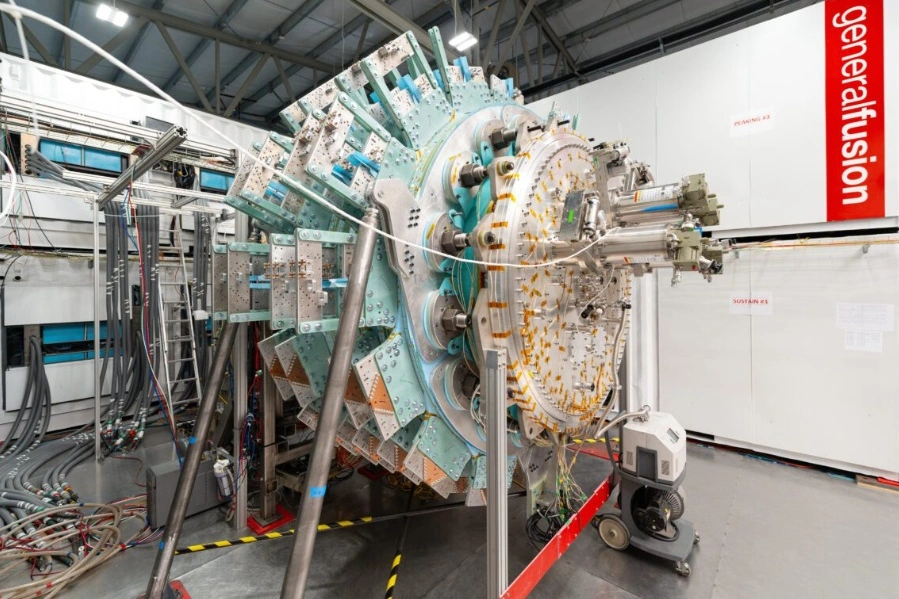
In late 2024, General Fusion announced that LM26 had successfully achieved fusion conditions exceeding 100 million degrees Celsius—equivalent to 1 keV in plasma physics terms. This temperature is the threshold necessary for initiating sustained fusion reactions. Even more remarkably, the machine is now routinely forming magnetized plasmas in its target chamber on a daily basis, a significant achievement that validates the machine’s design and operational capability.
This success places General Fusion years ahead of competitors pursuing different approaches and proves that their practical, market-oriented strategy is scientifically sound.
How LM26 Creates Fusion: The Magnetized Target Fusion Approach
Understanding how LM26 achieves fusion requires breaking down its innovative design. General Fusion’s Magnetized Target Fusion approach uses magnetic fields and mechanical compression to create fusion reactions—combining the best aspects of different fusion concepts while avoiding their most expensive components.
The process begins by creating a magnetized plasma “target” in the center of the machine. This plasma is confined by magnetic fields, keeping it stable and preventing it from touching the walls of the machine. This target contains the fuel—deuterium and tritium—ready for fusion.
Once the plasma target is established, the machine’s steam-driven pistons spring into action. These massive pistons compress the plasma in a fraction of a second, increasing the temperature and pressure at the core. The compression is so rapid and forceful that the nuclei are forced together despite their mutual repulsion, achieving the conditions necessary for fusion.
The entire process takes milliseconds, but in that tiny window, millions of fusion reactions occur, releasing energy that can be captured and converted to electricity.
The Critical Role of Liquid Lithium
One of LM26’s most innovative features is its use of liquid lithium, which serves multiple essential functions within the machine. The liquid lithium liner performs duties that would require complex, expensive systems in other fusion approaches.
First, the liquid lithium liner acts as the compression medium. When the pistons fire, they compress the liquid lithium, which in turn compresses the plasma target. This mechanical compression is what triggers the fusion reaction.
Second, the lithium liner protects the machine itself from damage. Fusion reactions produce high-energy neutrons that would bombard and gradually degrade solid structural materials. The liquid lithium absorbs these neutrons, preventing damage and extending the machine’s operational life.
Third, lithium enables fuel breeding. When neutrons strike lithium atoms, they can produce tritium—the fusion fuel that’s otherwise difficult to obtain. This creates a self-sustaining fuel cycle where the reactor essentially breeds its own fuel.
Finally, the liquid lithium provides an efficient method for extracting energy. When fusion reactions occur, their energy heats the lithium, which can then be circulated through heat exchangers to generate steam and drive turbines. This direct heating mechanism is far simpler than the complex heat transfer systems required in other fusion designs.
Key Features That Make LM26 Different
LM26 represents a fundamentally different approach to fusion than competing projects. Here are the key features that make it unique:
Magnetized Target Fusion (MTF): Unlike tokamaks (which use magnetic confinement alone) or laser-driven inertial confinement, MTF combines magnetic confinement with mechanical compression. This hybrid approach achieves fusion conditions using simpler, more affordable technology.
Steam-Driven Pistons: The compression system uses steam-driven pistons—technology that’s mature, reliable, and well-understood from industrial applications. This eliminates the need for the massive, expensive superconducting magnet systems that other approaches require.
No Superconducting Magnets or High-Powered Lasers: Other fusion approaches demand either enormous magnetic coils cooled to near absolute zero or city-sized laser facilities. LM26 achieves fusion conditions without either, dramatically reducing cost and complexity.
Liquid Lithium Liner: This single component performs the functions of a neutron shield, fuel breeder, and energy extraction medium—solving multiple engineering challenges simultaneously.
The Path to Commercial Fusion Power
General Fusion’s LM26 is more than a scientific experiment—it’s a stepping stone toward commercial fusion power plants. The machine’s results will validate the company’s ability to compress magnetized plasmas repeatedly and achieve fusion conditions at scale.
If LM26 continues to perform as expected, General Fusion plans to build a pilot commercial plant within the decade. This would be the first fusion power plant capable of delivering electricity to the grid—transforming humanity’s energy landscape in ways difficult to overstate.
The company believes that MTF power plants will produce economical fusion energy with durable, reliable machines, sustainable fuel production, and practical energy extraction. Unlike other fusion approaches that face massive barriers when scaling from demonstration to commercial operation, General Fusion’s design addresses these challenges from the outset.
The Future of Fusion Energy
Imagine a world where fusion power plants generate clean electricity anywhere on Earth, powered only by hydrogen extracted from water and lithium from the ground. These plants would emit no carbon dioxide, produce minimal waste, and operate safely without the risk of catastrophic failure. This is the future that fusion promises.
Unlike solar panels or wind turbines, fusion plants would generate consistent, continuous power regardless of weather conditions or time of day. They could be located near population centers, eliminating the transmission losses associated with distant power sources. The energy density of fusion fuel means operational costs would be minimal compared to fossil fuel or even current nuclear plants.
The global energy transition demands new solutions, and fusion represents the ultimate clean energy destination—a technology with the potential to satisfy humanity’s energy needs for millennia while preserving our planet for future generations.
Frequently Asked Questions About Fusion Energy
When will fusion power plants be operational?
General Fusion aims to have a commercial pilot plant operating within the 2030s. Other projects, such as ITER in France, are targeting the 2040s. The timeline depends on continued funding and technical progress, but the achievement of fusion conditions by machines like LM26 suggests we’re closer than ever.
Is fusion energy truly clean?
Yes. Fusion produces no carbon dioxide during operation and generates far less radioactive waste than fission. The primary byproducts are helium (used in balloons and cryogenics) and neutron radiation, which can be contained using appropriate shielding. There is no risk of runaway reactions or meltdowns.
How much does fusion fuel cost?
Deuterium can be extracted from seawater at approximately $1-5 per liter of water processed. Given that a fusion power plant would require only grams of fuel per day, fuel costs would be essentially negligible. Tritium is bred within the reactor from lithium, which is abundant worldwide.
What makes General Fusion’s approach different from other fusion projects?
Most major fusion projects use either magnetic confinement (tokamaks like ITER) or inertial confinement (laser-based systems like NIF). General Fusion’s Magnetized Target Fusion uses a hybrid approach that combines magnetic confinement with mechanical compression, achieving fusion conditions using simpler, less expensive technology without requiring superconducting magnets or powerful lasers.
Is fusion energy safe?
Fusion is dramatically safer than fission. The amounts of fuel in a fusion reactor at any moment are minuscule—a few grams at most. If the plasma escapes confinement or the reaction goes wrong, it simply cools and the fusion stops. There’s no possibility of a chain reaction or meltdown, and no large quantities of long-lived radioactive waste.
The Fusion Revolution Is Coming
The achievement of fusion conditions in the LM26 marks a pivotal moment in human history. For decades, fusion energy has been “always thirty years away”—a promising technology that never seemed to arrive. Today, that narrative is changing.
General Fusion has demonstrated that practical fusion power is achievable without the astronomical costs and complexity that have held back other approaches. Their success proves that fusion energy can be developed on a realistic timeline using proven technology.
The benefits of fusion—abundant fuel, zero greenhouse gases, inherent safety, minimal waste, and extraordinary energy density—make it the ultimate clean energy solution. As the world grapples with climate change and energy security, fusion offers a path forward that once seemed impossible.
The fusion revolution is no longer a question of if, but when. And with companies like General Fusion pushing the boundaries of what’s possible, that future may arrive sooner than we think.