
The Leisure Society Arrives: How AI and Robots Will Transform Work Forever
Read time:

Imagine waking up one morning in the year 2040, coffee in hand, and realizing you haven’t worked a single hour this week—not because you’re retired, but because you simply don’t need to. Your local manufacturing plant runs itself. Your groceries arrive via autonomous vehicles. Even your doctor’s appointment was conducted by an AI assistant so sophisticated you forgot it wasn’t human. This isn’t science fiction. It’s the inevitable next chapter of human civilization, and it arrives far sooner than most of us anticipate.
The convergence of artificial intelligence, advanced robotics, and autonomous systems is poised to fundamentally reshape everything we know about work, productivity, and leisure. What economists once called the “leisure society”—a theoretical future where technological abundance frees humanity from the necessity of traditional labor—is no longer a distant dream. It’s a demographic and economic shift already taking shape before our eyes.
The Economics of Automation: When Machines Become Cheaper Than Humans
Throughout history, whenever technology has enabled a tenfold or greater cost reduction relative to the existing system, disruption has inevitably followed. The printing press didn’t just improve writing—it democratized knowledge. The steam engine didn’t merely enhance manufacturing—it birthed the Industrial Revolution. Today, we stand at another such inflection point, where AI and robots are poised to deliver cost efficiencies that dwarf anything we’ve previously witnessed.
According to analysis from RethinkX, the lifetime costs of humanoid robots are projected to be far less than $200,000 from the start—and that’s just the beginning. Their forecasts suggest operational costs will drop to under $1 per hour before 2035 and under $0.10 per hour before 2045. To put that in perspective: the average human worker in developed economies commands an annual salary exceeding $50,000, plus benefits, sick leave, and retirement contributions. A robot asking for nothing but electricity and occasional maintenance represents not just an efficiency gain, but an economic paradigm shift.
Here’s what makes this truly revolutionary: instead of workforce growth being constrained by human population growth, available labor can now expand as fast as robots can be manufactured and deployed. Consider the math: integrating one million people into a country’s workforce might require $100 billion and twenty years of investment in training, infrastructure, and immigration. Adding one million humanoid robots to that same workforce might cost only $10 billion and take a single year. The velocity of change will be unlike anything in human experience.
Tesla’s Optimus and the Robotics Revolution
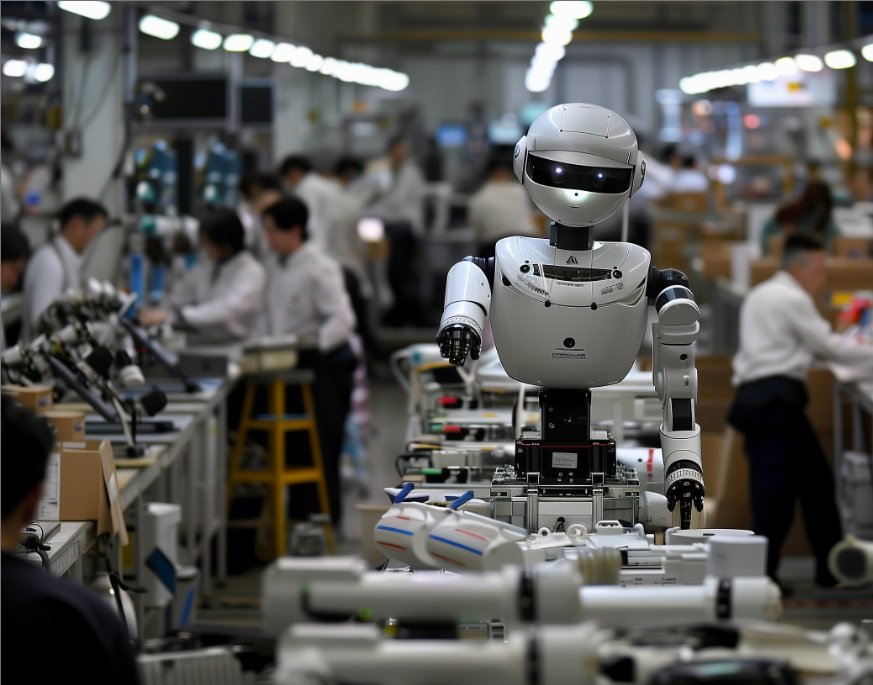
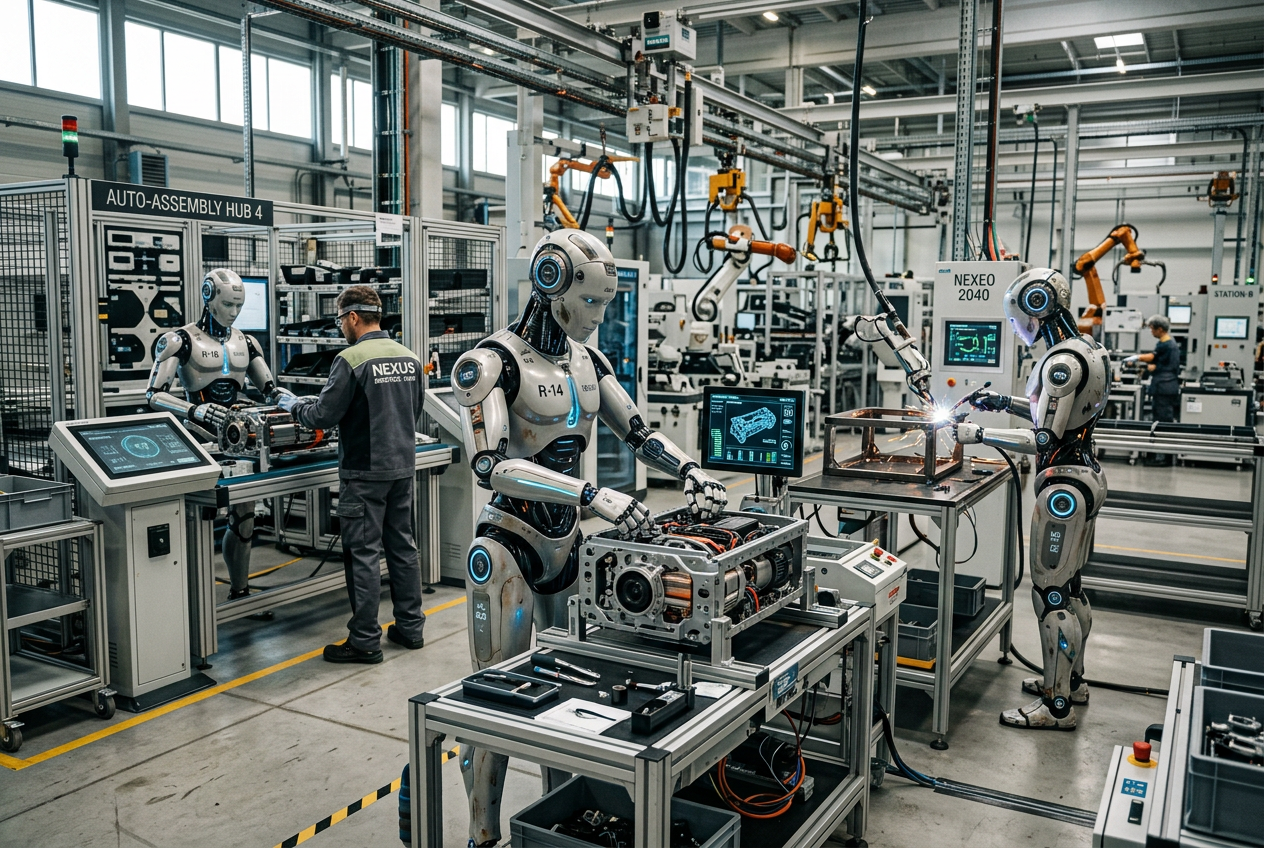
Among the most visible harbingers of this transformation is Tesla’s Optimus humanoid robot. Elon Musk has painted a bold picture: robots that increase global economic output by a factor of ten—or potentially even one hundred. His vision extends to “sustainable abundance,” with Optimus leading the charge into a new economic era.
The productivity mathematics behind this claim are striking. A single Optimus robot, operating around the clock without rest, vacation, or sick days, could achieve approximately five times the annual productivity of a human worker. Where a human might contribute 2,000 productive hours per year (accounting for weekends, holidays, and leave), a robot working continuously could contribute nearly 9,000 hours—more than quadruple the output before even accounting for speed and precision advantages.
For businesses, the financial incentives are compelling. Beyond eliminating salaries and benefits, robotic workers don’t require comfortable working conditions, safety equipment, or management overhead. They don’t unionize, don’t file complaints, and don’t experience fatigue-related errors. Companies adopting robotics technology can dramatically reduce operating expenses while simultaneously enhancing productivity and operational efficiency. The long-term savings on wages, benefits, and labor-related expenses make the transition to automation financially irresistible for many industries.
But this isn’t merely about corporate profits. When productivity soars while labor costs collapse, society gains the capacity to shift toward a leisure-focused lifestyle—one that emphasizes creativity, innovation, personal fulfillment, and the things that make life worth living beyond mere survival.
Economic Challenges in a Work-Optional Society
Yet before we arrive at this leisure paradise, significant economic challenges demand our attention. The transition to an automation-driven economy presents not only extraordinary opportunities but also profound challenges that require urgent attention.
The most pressing concern is wealth distribution. As companies replace human workers with robots, productivity gains flow primarily to capital owners—shareholders and executives—rather than to displaced employees. Without intervention, we risk creating a bifurcated society where a small elite controls the means of production while the majority struggles with diminished economic prospects. This disparity could generate social unrest, political instability, and widespread hardship.
Addressing these challenges will require innovative policy solutions and significant political will. Several approaches merit serious consideration:
- Robot Tax: Concepts such as a robot tax—where firms employing automation contribute to social welfare funding—could provide viable revenue streams for governments. This would offset displacement costs while maintaining incentives for innovation.
- Universal High Income: As envision by Musk and other futurists, governments could distribute a guaranteed income ensuring basic needs are met without requiring conventional employment. This isn’t welfare—it’s recognition that economic value increasingly derives from automation rather than human labor.
- Educational Initiatives: Promoting educational initiatives that empower individuals to engage with new technologies, retrain for emerging roles, and adapt to changing economic realities.
- Redefining Work’s Role: Society must fundamentally rethink the relationship between employment and identity, purpose, and social contribution.
These changes won’t happen automatically. They require deliberate societal consensus and the political will to implement transformative policies. The question isn’t whether we can afford such transitions—it’s whether we can afford not to pursue them.
Emotional and Psychological Impacts: Adjusting to a New Reality
Beyond economics, the shift toward a work-optional society poses significant emotional and psychological challenges. For generations, work has provided not just income but structure, purpose, social connection, and identity. What happens when these foundations are suddenly removed?
The emotional repercussions could range from feelings of depression and anxiety to existential uncertainty, as individuals transition from familiar structures to an uncertain future. Many people define themselves by their professions—the doctor, the teacher, the factory worker. When those roles become obsolete, who are we?
However, this disruption can also pave the way for potential reawakening and self-discovery. Freed from the necessity of labor for survival, individuals can explore their passions, develop new skills, pursue creative endeavors, and contribute to their communities in meaningful non-economic ways. The transition will be challenging, but the destination—a life defined by choice rather than necessity—holds tremendous promise for human flourishing.
Preparing for these psychological shifts requires proactive mental health support, community reinvention, and cultural narratives that help people envision fulfilling lives beyond traditional employment. Our schools, healthcare systems, and social institutions must begin adapting now.
Musk’s Vision: Universal High Income and Sustainable Abundance
Elon Musk’s thinking extends far beyond incremental improvements to existing systems. He envisions a future where several disruptive technologies converge within the next ten to twenty years: Transportation as a Service (TaaS), Product as a Service (PaaS), and of course artificial intelligence and robots working in concert.
Taken together, these technologies will create what Musk calls “sustainable abundance”—a condition where productive capacity far exceeds human needs, providing enough economic value for governments to share a Universal High Income with everyone. In this future, basic needs including food, housing, and healthcare would be guaranteed not through charity but through systematic technological abundance.
Musk’s vision seeks to tackle poverty at its root by ensuring universal access to essential goods and services. Rather than redistributing scarcity, this approach creates such overwhelming plenty that scarcity itself becomes obsolete. The implications for global poverty, inequality, and human suffering would be transformative.
Perhaps most radical is Musk’s argument that in an economy of genuine abundance, accumulating wealth would become meaningless. When everyone’s needs are met through automated systems, the pursuit of more—more money, more possessions, more status—loses its urgency. Individuals could instead engage more deeply with their passions and potential, thereby enhancing societal progress through creativity rather than competition.
While this vision may sound utopian, the technological foundations are being built today. Whether society chooses to distribute the benefits equitably remains the defining question of our era.
Preparing for Tomorrow: Actionable Steps Today
The future arrives faster than we think. While the full transformation may unfold over decades, the decisions we make in the next few years will shape whether that transition benefits humanity broadly or concentrates wealth dangerously. Here’s what individuals, businesses, and governments can do starting now:
- For Individuals: Cultivate skills that complement rather than compete with AI—creativity, emotional intelligence, complex problem-solving, and interpersonal relationships. Explore passion projects and side interests that could become meaningful pursuits in a leisure society.
- For Businesses: Plan for workforce transitions thoughtfully, investing in retraining programs and considering phased automation that maintains employment during transitions. Companies embracing human-machine collaboration will outperform those pursuing pure displacement.
- For Governments: Begin modeling economic scenarios, piloting universal income experiments, and building political consensus for transformative policies. The window for proactive planning is narrowing.
- For Communities: Develop social infrastructure that provides purpose and connection beyond employment—volunteer networks, creative collectives, lifelong learning programs, and supportive communities.
Frequently Asked Questions
When will the leisure society actually arrive?
While complete transformation may take several decades, the transition is already beginning. Experts suggest significant disruption in manufacturing, transportation, and service industries within the next ten to twenty years, with more comprehensive changes unfolding over the following decades.
Will there be any jobs left for humans?
While many traditional roles will be automated, new categories of work will emerge—particularly in creative fields, interpersonal services, AI supervision, ethics oversight, and roles we haven’t yet imagined. Humans will likely focus on tasks requiring judgment, empathy, creativity, and ethical reasoning.
How will people find purpose without work?
Historically, purpose has always derived from more than employment—family, community, creativity, learning, and helping others. A leisure society removes the economic necessity of labor while freeing time for these deeper sources of meaning.
Is universal high income realistic?
Technological feasibility exists—the economic question is political will. As automation generates unprecedented wealth, redirecting some of those gains to universal income becomes increasingly practical. Several pilot programs worldwide are testing various models.
What about people who want to work?
A leisure society doesn’t forbid work—it liberates it. People who find meaning in their professions will continue working, but from choice rather than necessity. Work becomes one option among many rather than the only path to survival.
Embracing the Inevitable: Your Role in Tomorrow’s World
The transformation underway isn’t a problem to be solved—it’s a transition to be navigated. The leisure society powered by AI and robots represents humanity’s greatest opportunity: the possibility that future generations will never know the desperation of poverty, the drudgery of meaningless labor, or the limitation of scarcity.
It won’t be easy. The path involves real challenges—economic disruption, psychological adjustment, political transformation. But the destination offers something genuinely unprecedented: a world where human potential can flourish unimpeded by economic necessity.
The future is faster than we think. The question isn’t whether this transformation will occur, but whether we’ll shape it consciously or simply endure it. The choices made in the coming years—by policymakers, business leaders, and ordinary citizens—will determine whether this technological revolution becomes humanity’s greatest achievement or its most costly mistake.
The time to prepare is now. Start conversations, advocate for thoughtful policies, develop new skills, and envision the life you want to live when work becomes optional. The leisure society isn’t coming—it’s already here. The only question is whether we’ll be ready to embrace it.