
OM System OM-1 Mark II vs Sony a7R IV: The 20MP Speed Demon vs The 61MP Resolution King
Read time :
15 min read
Note:
- All prices are in USD dollard.
- FPS (Frames Per Second) means the same thing of P (Progressive Scan) mean each frame is drawn at once.
- OM System OM-1 Mark II is the legacy of the Olympus OM-1. So we’ll call OM-1 II or Mark II
- Focal Length: An MFT sensor covers half the area of a full-frame sensor. When attaching a full-frame lens, you must double the focal length to find its equivalent field of view. For example, a 50 mm F1.8 Lens on an MFT camera body provides the same field of view and depth of field as a 100 mm F3.6 lens on a full-frame body.
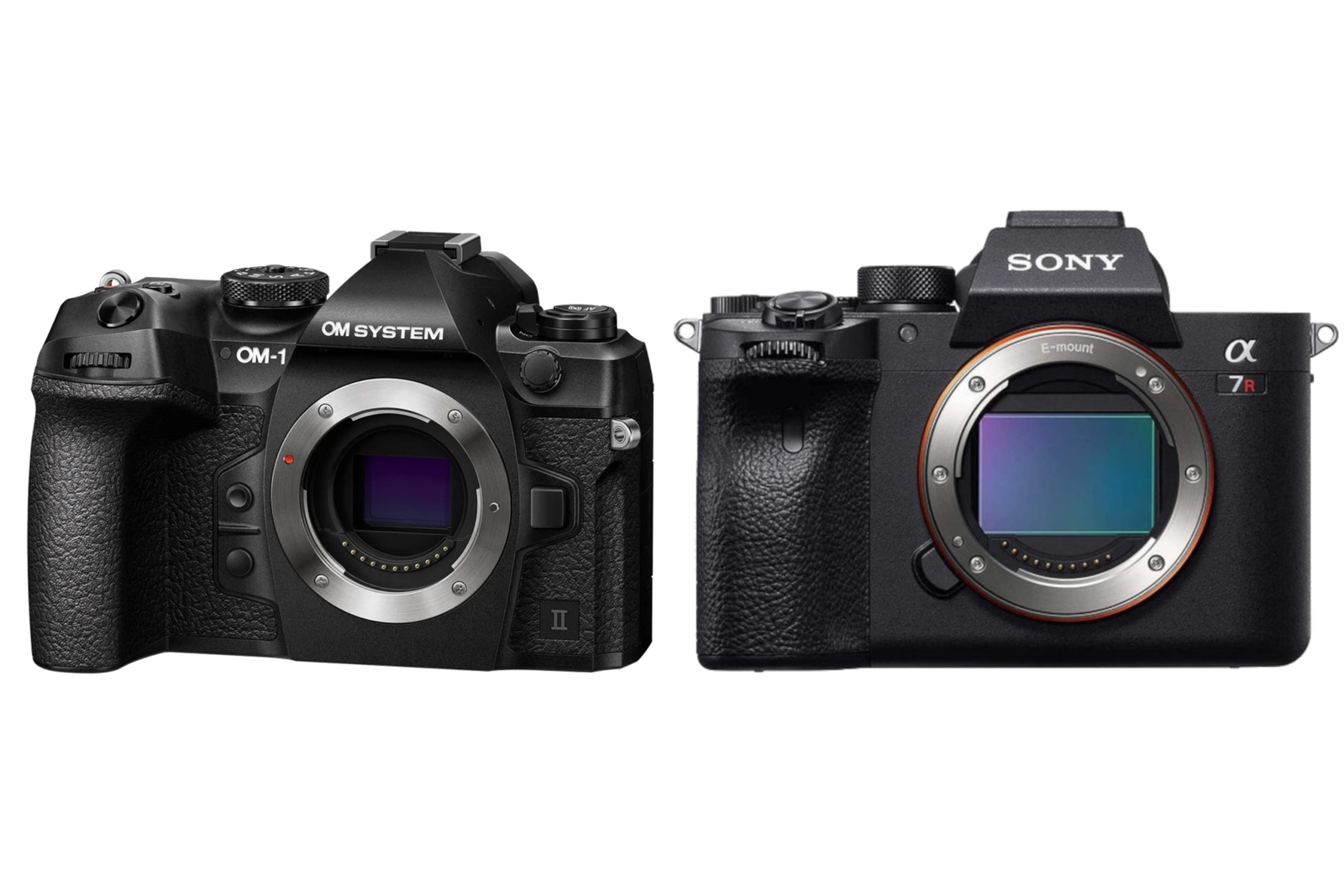
In the left corner, we have a camera that feels like it was designed by a mountain goat on caffeine: the OM-1 Mark II (Micro Four Thirds) body packing 20MP and computational sorcery that would make a NASA engineer blush. In the right corner, we have the Sony a7R IV, a full-frame behemoth strapped with 61 megapixels—enough resolution to count the eyelashes on a fly from across the street.
Comparing the OM-1 Mark II vs Sony a7R IV feels a bit like comparing a Ferrari F40 to a Rolls-Royce Phantom. One is built for blistering speed and agility; the other is built for breathtaking detail and opulent smoothness. Yet, camera buyers often find themselves torn between these two polar opposites. Why? Because both represent the absolute apex of their respective sensor formats.
This isn’t a simple “which is better” shootout. It’s a deep dive into a camera sensor size comparison that asks the ultimate question: do you need raw, unbridled resolution or raw, unbridled speed? Let’s dissect every parameter of the OM-1 Mark II vs Sony a7R IV—from sensor megapixels to shutter speeds, from burst rates to IBIS wizardry—and help you decide which flagship deserves a permanent spot in your camera bag.
Why You Should Care About This Showdown
For the uninitiated, comparing a Micro Four Thirds camera to a full-frame camera might seem like comparing apples to intercontinental ballistic missiles. But here’s the kicker: the OM-1 Mark II isn’t just any MFT camera. It’s a computational powerhouse that leverages its smaller sensor to deliver features like Live ND filters, Live GND filters, and a blackout-free electronic shutter that shoots at 120 frames per second (yes, you read that right). Meanwhile, the Sony a7R IV has been the go-to for studio photographers and landscape fetishists who demand pixel-level perfection.
If you’re looking at the Sony a7R IV vs OM-1 Mark II for bird photography, you’re probably already confounded. The Sony gives you room to crop; the OM System gives you frame-filling focal lengths with shorter lenses. For Sony a7R IV vs OM-1 Mark II for landscape, the Sony’s 61MP sensor can pull details from shadows that even vampires would miss, while the OM System can simulate long exposures without a tripod. This article will untangle those knots.
Let’s get technical—but keep it human.
Sensor MP: 20MP vs 61MP — The Obvious Elephant in the Room
The Numbers Game
The OM-1 Mark II packs a 20.4-megapixel stacked CMOS sensor. The Sony a7R IV boasts a 61.0-megapixel full-frame BSI CMOS sensor. On paper, the Sony’s sensor has three times more resolution. That’s not hyperbole; it’s arithmetic. A 20MP image is roughly 5184 x 3888 pixels, while a 61MP image clocks in at 9504 x 6336 pixels.
But here’s where nuance enters the chat. Sensor resolution isn’t the only factor in image quality. The OM-1 Mark II uses a quad-pixel AF sensor overlay and computational photography to extract maximum dynamic range from its smaller sensor. The Sony, meanwhile, leans hard on its native low noise and massive resolution.
Real-World Implications
If you’re printing billboards or cropping aggressively, the Sony a7R IV is your monastic shrine to detail. For web, social media, or prints up to 24×36 inches, the OM-1 Mark II’s 20MP are more than sufficient—especially when paired with OM System’s legendary Pro lenses. The camera sensor size comparison here isn’t about which sensor “wins”; it’s about which fits your workflow.
Key takeaway: The Sony offers incredible cropping flexibility. The OM System offers smaller files that are easier to edit, store, and transfer. If you’re a pixel-peeping landscape shooter, Sony. If you’re a run-and-gun shooter who values speed over cropping, OM-1 Mark II.
Shutter Speed & Burst — One Camera Is a Machine Gun
OM-1 Mark II: Ludicrous Speed
The OM-1 Mark II’s electronic shutter can hit 1/32,000 second with a burst rate of up to 120 frames per second when AF/AE are locked at the first frame. Does anyone need 120fps? Probably not. But it eliminates rolling shutter distortion and captures moments that mechanical shutters miss entirely. With its high-speed sequential mode, you can rattle off 50fps with full AF/AE—and all of this in complete electronic silence.
Compare that to the Sony a7R IV, which shoots 10fps with mechanical shutter or 7fps with electronic. That’s not slow; 10fps is perfectly respectable for a high-resolution camera. But going from 10fps to 120fps is like upgrading from a jog to a light-speed hyperspace jump.
Why Burst Matters for Bird Photography
The Sony a7R IV vs OM-1 Mark II for bird photography debate often centers on burst rate. Birds move fast. A swallow dive-bombing a pond? That’s a 1/5000 second moment. The OM-1 Mark II can spray 120 shots per second and let you pick the exact wing flutter you want. The Sony, even at 10fps, gives you fewer options but 61MP to crop heavily. Trade-offs abound.

Shutter Shock and Silent Operation
The OM-1 Mark II’s fully electronic shutter means zero mechanical vibration—critical for telephoto shooting where camera shake kills sharpness. The Sony a7R IV’s mechanical shutter is well-damped but, at 1/8000 second maximum, can’t compete with the OM System’s silence. For wedding or wildlife photographers, that silence is golden.
Key takeaway: If speed, silence, and sheer burst rate rule your shooting, the OM-1 Mark II wins by a landslide. If you prefer fewer, more deliberate shots at high resolution, the Sony is your tool.
IBIS (In-Body Image Stabilization) — The OM-1 Mark II Jedi Mind Trick
OM-1 Mark II 8.5 Stops of Magic
OM System has spent years refining its 5-axis image stabilization, and the OM-1 Mark II achieves 8.5 stops of compensation (CIPA-rated) with or not compatible lenses. That’s enough to hand-hold a 1/4-second exposure and get sharp results. Try that on a full-frame camera, and you’ll make friends with motion blur.
Why does this matter? For landscape photographers, the OM-1 Mark II’s IBIS allows you to shoot at base ISO in low light without a tripod. For Sony a7R IV vs OM-1 Mark II for landscape, the OM System’s IBIS edge lets you capture long-exposure-style images via the Live ND filter without carrying filters or a tripod.
Sony a7R IV’s 5.5 Stops
The Sony a7R IV offers 5.5 stops of correction. That’s what you’d expect from a modern full-frame camera. It’s good, but it pales next to the OM-1 Mark II’s gyroscopic wizardry. Where the Sony might start showing micro-jitter at 1/2-second handheld, the OM System can push to 1-second or longer.
Live ND & Live GND Filters: OM System’s Party Trick
The OM-1 Mark II’s Live ND filter allows you to simulate neutral-density effects in-camera—like a 6-stop or 9-stop ND filter—stacks multiple exposures to smooth water and clouds. Its Live GND filter does the same for graduated ND effects. These features are unique to OM System and transform the OM-1 Mark II into a computational landscape machine. The Sony a7R IV has no equivalent. If you shoot landscapes and hate carrying filters, this is a compelling reason to choose the OM-1 Mark II.
Key takeaway: IBIS is an OM System superpower. For handheld low-light work or filter-free landscape shooting, the OM-1 Mark II is vastly superior.
Viewfinder Resolution — Seeing Is Believing
OM-1 Mark II: 5.76-Million-Dot OLED
The OM-1 Mark II features a 5.76-million-dot OLED electronic viewfinder with 0.83x magnification and 120fps refresh rate. It’s insanely bright, lag-free, and provides a seamless view of the world—no blackout even during bursts. For action shooting, this viewfinder is pure gold.
Sony a7R IV: 5.76-Million-Dot UXGA
Wait—they’re the same resolution? Not exactly. The Sony’s EVF is also 5.76 million dots but at 0.78x magnification and 100fps refresh. It’s excellent but not as fluid or large as the OM-1 Mark II. Both are class-leading, but the OM-1’s higher magnification and smoother refresh give it an edge for tracking fast subjects.
Key takeaway: Toss-up, but the OM-1 Mark II edges ahead for action shooters who need zero lag.
Special Features — The OM-1 Mark II’s Bag of Tricks
Live ND / Live GND — Already Covered, But Worth Repeating
The OM-1 Mark II’s Live ND filter and Live GND filter are game-changers for landscape photographers who hate carrying filters. The Sony cannot replicate this without post-processing.
Pro Capture Mode
Pro Capture lets the OM-1 Mark II start recording frames before you fully press the shutter. It’s pre-buffering for action—if you’re shooting a bird taking flight, you can capture the moment a split-second before you react. The Sony a7R IV has a similar feature but only at 6fps in uncompressed RAW files. The OM-1 does it at up to 50fps.
High-Res Shot Modes
The Sony a7R IV can do Multi-Shot High-Res (approx 240MP) but requires tripod and 16 exposures. The OM-1 Mark II’s high-resolution handheld mode lets you take 12 consecutive photos, using its built-in image stabilization (IBIS) system to shift the sensor by microscopic fractions of a pixel to create a single 50-megapixel image. In addition, when used with a tripod, the OM-1 Mark II can also capture 8 consecutive images (shifting the sensor in half-pixel increments) and then merge them into a highly detailed 80-megapixel RAW image.
AI Subject Detection
Both cameras offer AI-powered subject detection for birds, animals, cars, and humans. Sony’s system is excellent but slightly slower to lock in low contrast. OM System, refined in the OM-1 Mark II, is now extremely accurate, especially for birds in flight.
Key takeaway: The OM-1 Mark II is a feature-packed Swiss Army knife; the Sony a7R IV is a laser-focused tool for maximum resolution.
In addition, you can purchase the first-generation OM-1 at a much more affordable price. This camera, which bears the “Olympus OM” brand, offers the same features but is slightly less capable, as the Mark II has a larger buffer and is equipped with a built-in Live GND filter. However, it has become increasingly difficult to find a new one on the market lately. Here is a comparison of the OM-1 Mark II vs. the OM-1:
| OM Features | OM Sytem (OM-1 Mark II) | OM Olympus (OM-1) |
|---|---|---|
| Built-in Live GND (Graduated Neutral Density) | GND2 to GND8 (3 stops) | Not Available |
| Built-in Live ND | ND2 to ND128 (7 stops) | ND2 to ND64 (6 stops) |
| Image Stabilization – body-only stabilization – with Sync IS Lens | 8.5 EV stops in both cases | 7.0 EV stops 8.0 EV stops |
| Pro Capture AF/AE mode works only on the SH2 with a PRO Lens | Low: 20 fps SH1: 120 fps SH2: 50 fps | Low: 20 fps SH1: 120 fps SH2: 50 fps |
| Max RAW Frames at 120 fps | 213 | 92 |
| Output RAW File | 14-Bit Hi-Res Shot | 12-Bit High Res Shot |
Image Quality — The Great Sensor Divide
Dynamic Range and Color
The Sony a7R IV’s full-frame sensor brings approximately 14 stops of dynamic range at base ISO, producing files with shadow recovery that borders on sorcery. The OM-1 Mark II, with its smaller sensor, offers around 12.5 stops. In practice, that means the Sony can pull details from deep shadows without introducing noise, while the OM System will show more noise past ISO 6400.
But as already mentioned in the Special Features section, the OM-1 Mark II’s computational photography—much like its multi-shot Hi-Res mode—allows it to approach the dynamic range of a larger sensor by producing a 50 MP JPEG file or by using tripod-based modes up to 80 MP, the OM-1 can reproduce more detail than its native 20 MP resolution would suggest. That said, in terms of single-shot image quality, the Sony a7R IV remains the king.
Noise Performance
At low ISOs (100-800), both cameras produce clean files, but at ISO 3200 and above, the Sony pulls ahead. The OM-1 Mark II is usable at ISO 6400 with careful noise reduction, but the Sony remains clean at ISO 12800. This is the physics of sensor size: larger pixels gather more light.
For Sony a7R IV vs OM-1 Mark II for bird photography, high ISO performance matters because you need fast shutter speeds in dim light. If you shoot dawn/dusk wildlife, the Sony’s superior noise control gives you more leeway.

Lens Ecosystem and Equivalent Reach
The OM-1 Mark II’s 2x crop factor means a 400mm lens becomes an 800mm equivalent. Pair it with OM System’s 300mm f/4 Pro (600mm equivalent), and you have a compact, lightweight birding setup that rivals full-frame 600mm primes costing ten times as much. The Sony a7R IV, with its full-frame lens system, demands larger, heavier glass to reach similar focal lengths—but its 61MP sensor allows you to crop a 200mm shot to a 300mm field of view without losing detail.
Key takeaway: The OM-1 gives you equivalent reach with lighter lenses. The Sony gives you cropping power from its massive resolution.
Weight, Size, and Build — The Ergonomic and Portability Factor
OM-1 Mark II: Lightweight Ruggedness
The OM-1 Mark II weighs 579g (body only with battery) and measures 138.8 x 91.6 x 71.0 mm. It’s magnesium alloy, dustproof, splashproof, and freezeproof to -10°C. With its deeply contoured grip, it fits like a glove—perfect for long hikes or wildlife treks.
Sony a7R IV: Built Like a Tank, Heavier Tank
The Sony a7R IV tips the scales at 665g and is slightly larger (128.9 x 96.4 x 77.6 mm). It’s also weather-sealed but not quite as robust as the OM System. The difference of 86g doesn’t sound huge, but when you add lenses, the OM-1 setup often ends up 30-40% lighter.
Lens Weight: The Hidden Factor
Here’s where MFT saves your back. The OM System Zuiko 12-100mm f/4 Pro (24-200mm equivalent) weighs 561g. An equivalent Sony full-frame 24-105m f/4 G OSS weighs 663g. Over a full kit—body + 2-3 lenses—the OM-1 system can be 1-2kg lighter. For travel or hiking, that’s transformative.
Price: How Much Does Each Cost?
Cameras prices and lens costs vary—as of 2026, the OM-1 Mark II body retails roughly for $2,199, while the Sony a7R IV sits around $2,500 (though increasing with recent stocks). Lens costs tilt heavily toward Sony. A high-quality Sony 400mm f/2.8 GM is $11,500 vs the OM System Zuiko 300mm (600mm equivalent ) f/4 Pro is $2,500. Over a lifetime, the OM-1 system saves thousands.
Key takeaway: OM-1 Mark II wins on portability and system cost. Sony wins on sensor size but charges a premium.
The Bottom Line: Which Camera Should You Buy?
By now, you’ve seen the raw stats, the trade-offs, and the quirks. Let’s make this actionable.
Choose the OM-1 Mark II if:
- You shoot wildlife, sports, or fast action—the 120fps burst and Pro Capture are unmatched.
- You want lightweight gear for travel or hiking—the OM-1 system is significantly lighter.
- You love computational photography like Live ND filters or high-res modes without a tripod.
- You shoot in extreme weather (rain, dust, cold).
- Budget is a concern—lenses are far more affordable in the MFT ecosystem.
Choose the Sony a7R IV if:
- You need maximum resolution for large prints, cropping, or commercial work.
- You shoot studio portraits, architectural details, or landscape scenes where high ISO performance matters.
- You want to use full-frame lenses with shallow depth-of-field capabilities.
- You’re willing to carry heavier gear for the ultimate image quality.
| Features | OM Sytem (OM-1 Mark II) | Sony a7R IV |
|---|---|---|
| Sensor Resolution | 20.4 MP (Stacked BSI) TruePic X Handheld High Res Shot 50 MP | 61MP Exmor R BSI-CMOS |
| OM-1 Mark II Pro Capture Mode AF/AE mode works only on the SH2 with a PRO Lens | Low: 20 fps, SH1: 120 fps SH2: 50 fps | None |
| Sony a7R IV Hi+ and Real-time Tracking AF | None | 10 fps maximum |
| Shutter Speed (elec.) | 1/32,000 | 1/8,000 |
| IBIS (In-Body Image Stabilization | Up to 8.5 stops | 5.5 stops |
| Live ND / Live GND | Yes (built-in) | No |
| EVF Resolution | 5.76M dots 0.83x magnification and 120fps refresh | 5.76M 0.78x magnification and 100fps refresh |
| Autofocus Points | 1,053 – – Cross-type Phase Detection – Covering 100% of the sensor | 567 – Phase-Detection – 99.7% vertical, 74% horizontal |
| Video | 4K – 60fps 10-bit 4:2:2 internal 1080p -up to 240fps | 4K – 30fps 8-bit 4:2:0 Internal 1080p – 120fps |
| Weight (body) | 599 g | 657 g |
| New Body Price (approx.) | $2,200 | $2500 |
| Lens Weight (kit zoom) | ~382g (12-40mm f/2.8) | ~886g (24-70mm f/2.8 GM) |
Frequently Asked Questions
Is the OM-1 Mark II better than the Sony a7R IV for bird photography?
Yes, in most cases. Its faster burst rate, blackout-free viewfinder, Pro Capture, and 2x crop factor give it an edge. However, if you often shoot in low light and need to crop heavily, the Sony’s 61MP offers more flexibility after the shot.
Can I get similar image quality to the Sony a7R IV from the OM-1 Mark II?
In good light and with careful technique, yes—especially using the 80MP high-res mode on a tripod. In low light or high ISO, the Sony wins clearly due to its larger sensor.
Which camera has better video features?
Both offer 4K video (OM-1 at 60p, Sony at 30p). The OM-1 Mark II supports 10-bit 4:2:2 internal recording and has better stabilization for handheld video. The Sony a7R IV has superior low-light video but limited frame rates. For vlogging or run-and-gun video, the OM-1 is better.
How do the cameras compare for landscape photography?
For Sony a7R IV vs OM-1 Mark II for landscape, the Sony’s 61MP and superior dynamic range edge it ahead for static scenes. But the OM-1’s Live ND filters, lighter weight, and incredible IBIS make it more versatile for outdoor adventure landscape work.
Conclusion: The Camera That Fits Your Life
The OM-1 Mark II vs Sony a7R IV comparison isn’t about finding a winner. It’s about finding your winner. Each camera excels in a distinct domain. The OM-1 Mark II is the camera for photographers who chase the moment—who want speed, portability, and creative tools that feel like cheating. The Sony a7R IV is the camera for photographers who obsess over every detail—who want to extract the maximum possible quality from every pixel.
Actionable advice: If you’re torn between these two—buy the OM-1 Mark II if you shoot action, travel, or wildlife. Buy the Sony a7R IV if you shoot studio, macro, or landscapes where every pixel counts. Whichever you choose, both will inspire you to shoot incredible images. Now, stop reading and go photograph something.